


Attention is the scarce resource.
AI and robots will make products, content and services almost free. So the bottleneck moves. Your time is finite. The supply of stuff that wants your eyes is not.
That makes the places that capture and hold real human attention the best real estate in advertising. Let me show you where it’s going right now, including agents, and who I think comes out ahead.
Social and video feeds
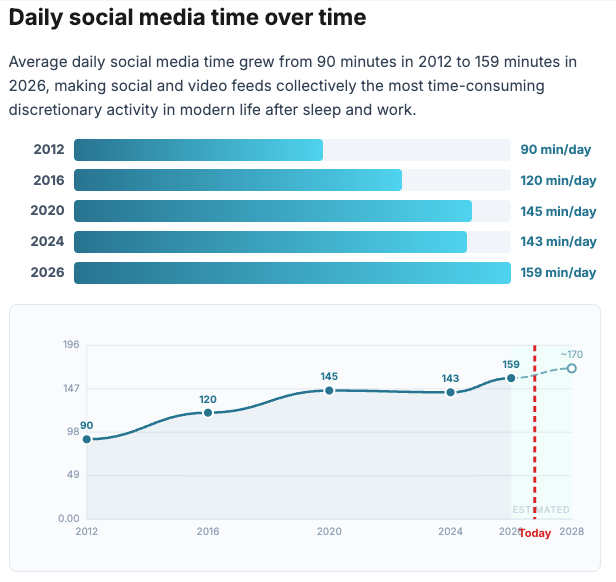
This is still the biggest sink. DataReportal’s Digital 2026 (GWI survey data) says the average online adult spends 18 hours 36 minutes a week on social networks and video feeds combined. Well over 2.5 hours a day.
Meta’s apps hit 3.60 billion daily active people in Q2 2026, up 3%. Growth is slowing. Time spent is not: Instagram time grew double digits year over year, and Facebook video time rose 9%. Instagram is now at 2 billion daily actives.
$META, YouTube, TikTok and X own the feeds, the data and the distribution. News sites and open-web display lose here. They can’t match the loop.
Gaming
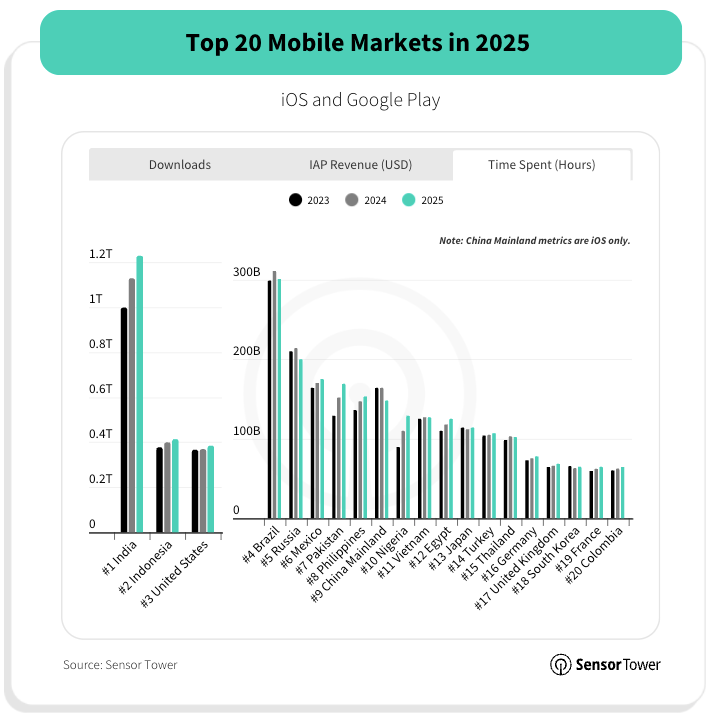
Mobile gaming is mature, but people don’t leave. Sensor Tower’s State of Mobile 2026 says users spent 5.3 trillion hours in apps in 2025, about 3.6 hours a day per user. Gaming in-app revenue was close to $82 billion, up only 1.3%. Downloads fell, time spent rose a bit. Same players, deeper engagement.
Winner: APP 0.00%↑ . Losers: utility apps and passive browsing, because they don’t build the same loop.
Long-form video and CTV
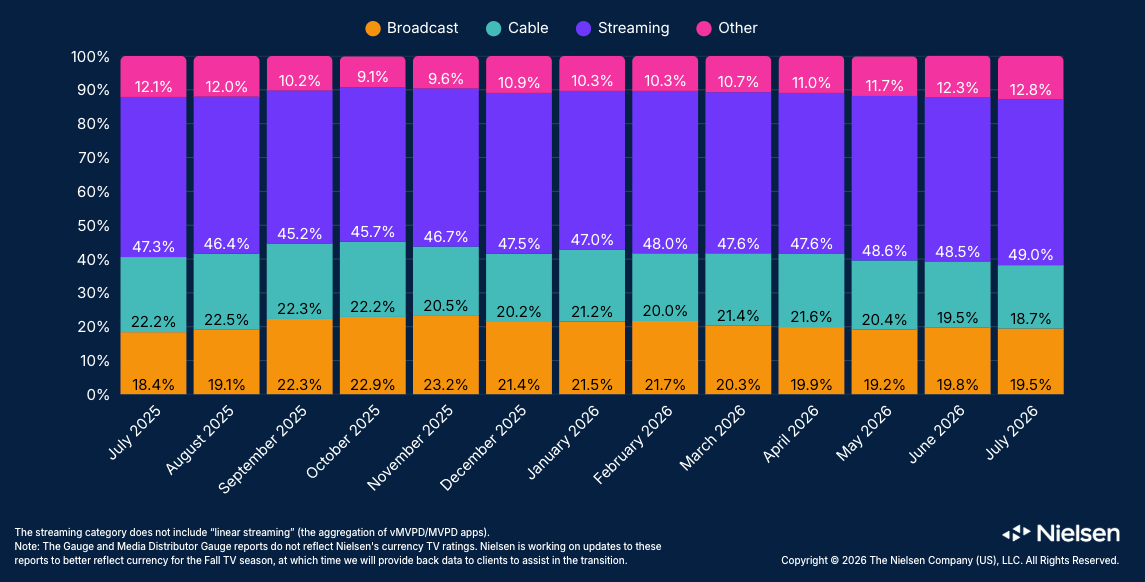
YouTube keeps taking time. Digital i measured average daily viewing per account at 99.1 minutes in 2025, up from 87.2 in 2024. That’s more than Netflix, which dropped from 100.5 to 93.4. YouTube’s share of viewing on the TV screen went from 28% to 35%. The living room is the next fight.
GOOGL and Netflix are in the best position, along with any CTV player that can prove performance. Wurl ($APP) has a foothold, but it’s early. Linear TV is the loser.
Messaging
WhatsApp passed 3 billion monthly users in 2025. Similarweb’s Android data shows about 89% daily stickiness. People open it all day, even if each session is short.
$META wins this one almost by default. Broadcast-style social, with no real two-way interaction, doesn’t.
Agents
Fastest growing thing I can find.
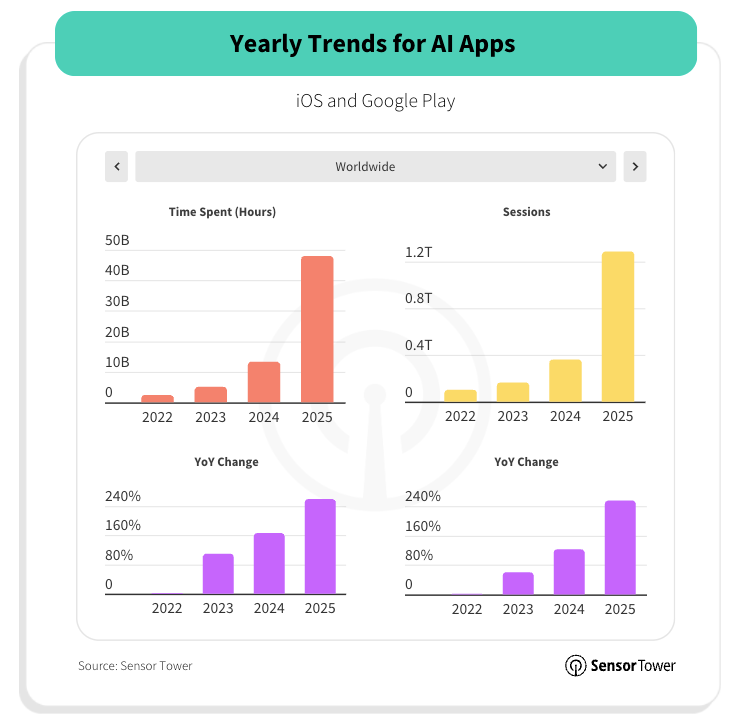
Sensor Tower says time in generative AI apps hit 48 billion hours in 2025, about 3.6x 2024. Its State of AI 2026 projects 36 billion hours for H1 2026 alone, against 17.2 billion a year earlier. ChatGPT told us it has 1.2 billion weekly users (Sept 29, 2026). It was 400 million in February 2025.
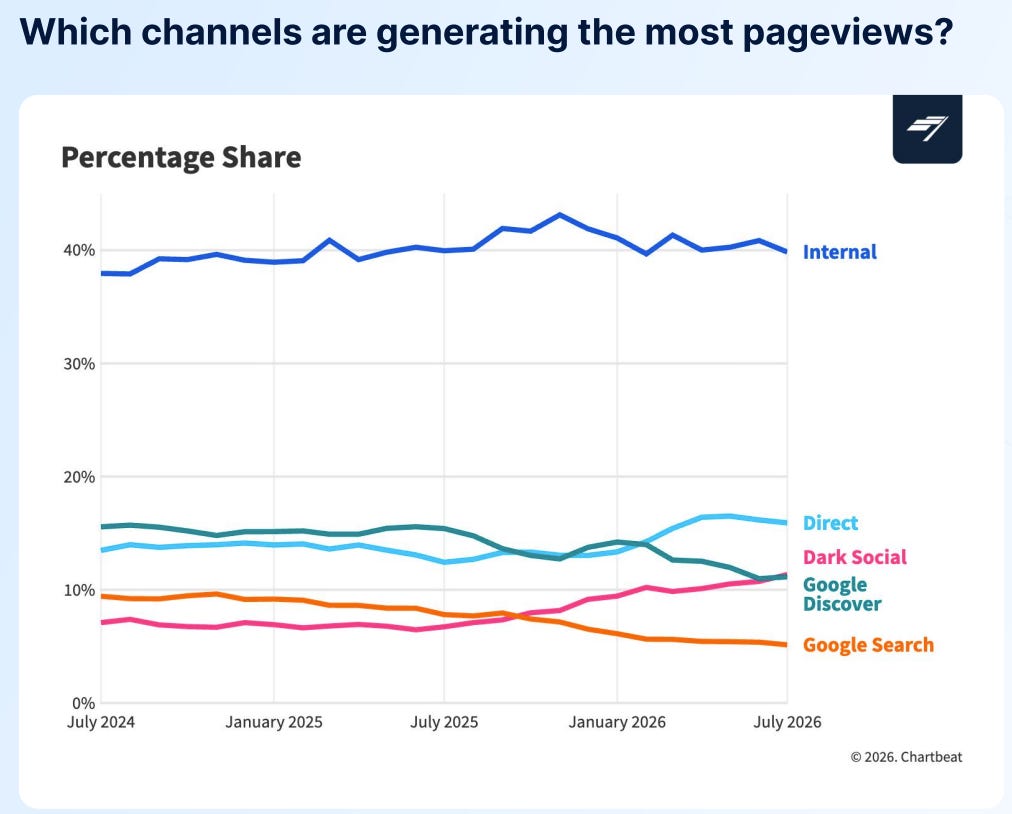
Agents take the boring work: research, comparison, filtering. That hurts search. Chartbeat saw Google Search referrals to its publisher network fall 40% year over year to July 2026, after a 22% drop the year before. SparkToro’s study found 68% of US desktop Google searches ended without a click. Careful with that one: it’s browser data, and it’s one study. Search is still huge. But for publishers the direction is clear.
So the agent interface becomes a new place to sell things.
Winners: whoever owns or plugs into the leading agents. OpenAI, $GOOGL, $META, Anthropic, SpaceX. Losers: pure search, and shopping sites that live off long manual browsing.
Where ad value ends up
Ads are worth most where attention is dense, measurable and hard to hand to an agent. That means algorithmic video feeds, gaming and the big video platforms. People will keep spending that time themselves.
And a new surface is forming inside the agent layer. Whoever gets preferred by agents, or finds a way into the human-agent decision loop, takes a growing slice of money that used to sit in search. Everyone else gets squeezed as the noise grows.
Two ways to monetize attention
One: own the real estate where ads show up. $META, $GOOGL, TikTok, X.
Two: be better than everyone at deciding which ad goes where and at what price. The first needs scale of attention. The second needs data and a model that turns it into predictions.
$APP sits in between, and its edge is the closed loop connecting the two.
What AppLovin actually does
AppLovin runs MAX, a mediation platform, and AXON, a prediction model. A game publisher drops in the SDK. That opens ad slots in the app and lets MAX run a real-time auction across demand sources: AppLovin’s own, $META, $GOOGL, $U and others. The publisher gets paid. AppLovin takes a cut and sees every bid, the clearing price and, through the SDK and advertiser reporting, what happens after the ad.
AXON bids on behalf of AppLovin’s advertisers. It predicts how likely this user, in this app, right now, is to convert for this advertiser. Better prediction means smarter bids and more inventory won at a profit.
The closed loop
An impression opens up in a game. MAX sends a bid request. AXON reads what it can see: app, device, time, recent session behavior, how similar users did in similar contexts, past auction results. It bids. If it wins, the ad runs. Later the advertiser reports whether the user installed or bought. That outcome goes back into the model.
Because MAX runs the auction, AppLovin sees more than its own bids. It sees the clearing price and that others bid, plus the result. A typical demand-side platform only knows if it won or lost. AppLovin sees the shape of the market for that impression and what came after. That extra signal compounds.
So the model gets better at telling good impressions from bad ones. Advertisers with better returns spend more. More spend, more auctions, more feedback. Publishers get better fill rates and eCPMs, so they keep the SDK. The loop feeds itself.
Here’s Adam Foroughi, cofounder and CEO, on the Q1 2026 call (May 6):
The team improves the model, advertisers see better returns and they put more budget into our system. It is a virtuous cycle, and it is working.
Behavior over identity
The data in this loop is mostly behavioral and contextual. It isn’t a big deterministic identity graph. After Apple’s App Tracking Transparency, persistent cross-app identifiers got much harder to use at scale. AXON doesn’t need to know it’s the same person across ten apps. It learns patterns: people who act like this, in apps like this, at times like this, convert at this rate. Auction history and conversion feedback are the labels. Identity helps when it’s there. It isn’t the main input.
That’s why AppLovin can say its economics improve as the models improve. The inventory is mediated, not owned. The edge is pricing it more accurately than other bidders, with a feedback loop most of them can’t copy.
And AppLovin is big in this market. Sensor Tower puts $APP and Google AdMob together at roughly 65% of global mobile game ad revenue (Jan 2025 to May 2026), with AppLovin alone at 36% and AdMob at 29%. On the mediation side, GameBiz Consulting found MAX in 73% of top-downloaded ad-supported games and 55% of top-grossing ones (March 2025 data).
Where the next growth comes from
On the Q2 call (August 2026), Foroughi said: “Over the longer term, as we continue improving gaming and expanding consumer, we believe this business can compound at roughly 30% annually.”
My read: the easy part is taking the same mobile real estate to consumer and e-commerce advertisers.
The inventory stays the same, mobile game slots through MAX. What changes is the demand. Gaming advertisers already know how to buy here. Bigger consumer brands need clearer measurement, first-party data integration and proof of ROAS before they scale. Partnerships with analytics tools like Triple Whale and Northbeam give AppLovin a targeted way in. Same real estate, better demand.
On the Q1 call he was clear this is early:
In e-commerce and now what we’re calling consumer, this product is really early. So it’s like AXON 2.0, call it, 10 quarters ago. We’re going through the phase of not only rolling out a model and understanding what the consumer needs, but also then on the other side, getting more data into the system.
As we add more advertisers, we get more data, then we can build a more sophisticated model that can process it and create better output. So we’ve been continuously doing that. Last quarter earnings, I mentioned we just had one new model that had just created an uplift. The one we just had a couple of weeks ago was quite substantial.
On Q2 he added that consumer advertiser spend set another record, 28% above Q4 2025, the seasonal peak.
Streaming is where AppLovin adds new inventory. It bought Wurl in 2022 and got a connected-TV supply and measurement layer. The plan is to run AXON-style bidding on CTV. Attention is high there, attribution has been weaker than in mobile gaming. And CTV doesn’t have the dense in-session signals games give MAX. Early, but it widens the surface.
Then Gist. AppLovin published its own social app in May 2026, quietly. The idea is first-party, deterministic signals that feed AXON and don’t depend on third-party apps. It’s the most direct try at owning both the real estate and the closed-loop data outside gaming.
AppLovin already dominates the number 2 attention market (gaming) and wants into number 1 (social) and number 3 (long-form video).
Conclusion
What AppLovin has built is close to a digital twin of how attention works while someone plays a game. A model that predicts what grabs a human in that moment.
Now they want the same for social and long-form video.
For video, the plan looks like the gaming one: they’re the “Airbnb” of the real estate. Hosts own the rooms, AppLovin matches and prices. For social they want to own the real estate itself, so they’re building a network.
I think Wurl will likely work over time. Gist? I doubt it. A social network from scratch is less about using data well, which is their core business, and more about an art that very few have mastered in the last twenty years. And if it did work, it would mean hundreds of millions of monthly users pulled out of walled gardens that have been thriving for a long time.
But they don’t need either bet to win. The macro dynamics I laid out at the top are enough for me to believe $APP can grow 20%+ for the foreseeable future. Management talks about roughly 30% a year, and Q3 guidance sits at 46% to 48% growth.
On valuation: $APP trades at a trailing P/E of roughly 21 to 24, and about 15 to 17 on forward earnings. For a business growing like that, I think it may be severely undervalued.
If you want access to:
My portfolio
all my trades in real time
my price targets and how I calculate them
Business Ontology content
My price targets will be shared in the Telegram Group and explained on my Youtube channel.
I share my thoughts on X.
Please note that:
I can be and will be (hopefully not often) WRONG. This is just my personal strategy—NOT FINANCIAL ADVICE. I don’t know your financial or life situation well enough to give any recommendations. Please do your own due diligence and research. Don’t be LAZY.
Be the architect of your own destiny.
Ciao
Lorenzo