


Hims is going after something that nobody has ever reached in healthcare.
And that is, at least partially, by design.
Imagine you could feed millions of real patient data points — lifestyle habits, drug side effects, actual effectiveness, diet, medical history, genetics, even where people live — into one giant brain that connects all the dots. The endgame? Healthier humans who, over time, need fewer and fewer medicines.
Now ask yourself: who on earth has the economic incentive to sell less medicine?
Not Big Pharma. Not the food industry. And definitely not governments (who are just the political branch of the first two).
Sure, there are thousands of amazing doctors doing heroic work one patient at a time. Respect. But that doesn’t move the needle at a population level.
This is the genius of what Andrew Dudum is building: he is going to reduce total drug sales (and drug prices) by selling drugs.
It’s the glitch the current system never saw coming, and it’s the reason Hims is still allowed to exist and compound like crazy.
In plain English: Hims is chasing the holy grail of healthcare — a true network effect.
The more users on the platform → the more data → the smarter the recommendations → the better the outcomes → the lower the prices → the more users. Rinse and repeat forever.
So why isn’t this network effect already exploding in the numbers?
Because it is literally just about to start.
The missing piece was cheap, powerful generative AI that can actually make sense of messy longitudinal health data. That piece is now here and dropping in price every quarter.
Everyone can use the AI, sure. But only the company that owns the data wins.
And guess who is about to own the richest trove of consumer-driven, outcome-tracked health data on the planet?
We believe the breadth of data on our platform and its utility value in helping our subscribers optimize their health will meaningfully increase with the launch of deeper diagnostic testing… This can come in the form of data-driven treatment recommendations, chatbots… or AI-assisted tools such as nutritional coaches. We are already seeing early wins…
– Yemi Okupe, CFO, Q3 2025 earnings call
Lab testing for deep health insights.
Wearables for lifestyle data.
MedMatch + future AI as the brain.
In-house compounding facilities to produce whatever the brain says you actually need.
Do you see the pattern yet?
Our goal is to one day help identify and manage risks associated with heart disease, metabolic disorders, neurodegenerative diseases and cancer, long before symptoms appear… We believe that combination positions Hims & Hers to do what few others in health care can: turn data into tailored action for millions of people.
– Andrew Dudum, Q3 2025 earnings call
And the flywheel needs constant fuel: new verticals keep coming. Testosterone is only the latest one, but you’ll see many more — menopause, heart markers, sleep optimization, mental performance… every new specialty is another magnet to pull millions of new users onto the platform.
And then there is the longevity vertical — the one that really makes the incumbents sweat. This is about giving regular people access to therapies (peptides, coenzymes, next-gen GLP/GIP combos, research-backed off-label molecules) that have been locked for years behind $10k-a-year concierge clinics or shady grey-market sites. Big Pharma never had an incentive to democratise them because the math only works at tiny volumes and insane margins.
Hims is flipping the script: produce them at scale in its own California peptide facility, crash the prices, and bundle them into the platform.
These capabilities alongside our California-based peptide manufacturing facility… form the foundation of the longevity specialty we plan to launch in 2026. Over time, we expect these will include peptides, coenzymes, GLP and GIP treatments designed to improve performance, recovery and cardiometabolic longevity markers.
– Andrew Dudum, Q3 2025 earnings call
Translation: starting next year, Hims will sell the same stuff that the Silicon Valley elite has been injecting in private clinics… to everyone, at a fraction of the price.
Every new user that comes for longevity (or testosterone, or menopause) adds more data points → better AI → better personalization → lower prices → even more users.
That’s the network effect actually kicking in.
And what if the compounding network effect takes longer than expected?
No problem. Hims just passes the extra pennies back to customers to keep the user growth engine roaring.
By the end of 2026, we plan to fulfil the majority of compounded GLP-1 orders through our own internal facilities — an important milestone that we believe will accelerate our ability to lower pricing… Recently, our progress put us in a position to strategically reduce prices across compounded GLP-1 plans by as much as 20%.
– Yemi Okupe, Q3 2025 earnings call
Eventually, the product stops being “medicines.”
Eventually, the product becomes a health-optimization subscription that gets magically better and cheaper the bigger it gets.
Together, these initiatives underscore the strength and potential of our platform and the power of our model: leveraging scale, data, and customer insights to continuously improve accessibility and customer experience, all without sacrificing quality.
A probable scenario: one day Hims sells most medicines at close to cost. On top of that it offers — thanks to its data moat — the best proactive health service on earth. How much would 10% of the 1 billion adults over 30 in US/Europe/Canada pay for that bundle? $20/month feels conservative. That’s $24 billion a year of high-80s-margin subscription revenue. Before you add drug sales, partnerships, advertising, B2B, etc.
Can you see it now?
No incumbent can copy this. This is the innovator’s dilemma on steroids — except here the consumer captures almost all the value created.
So yes, if Andrew executes, he is playing 4D chess.
Which brings us to the only question that actually matters right now.
Can we trust Andrew?
Because when you listen to him and to Yemi, the picture looks a lot less ugly than the market is pricing.
Personalized subscribers +54% YoY.
Multi-condition subscribers +80% YoY and already >20% of the base.
Excluding the deliberate transition away from on-demand ED pills, subscriber growth was north of 40% YoY — basically double the headline 22% number.
Yemi on the call:
Our expectation is that the effects of this transition will meaningfully dissipate in the second half of next year. We believe… in conjunction with the launch of new offerings such as testosterone [we will see] accelerating growth in the second half of 2026 within our Hims portfolio.
Translation: management is openly telling you that subscriber growth is bottoming right now and should re-accelerate in H2 2026. I think they are being conservative.
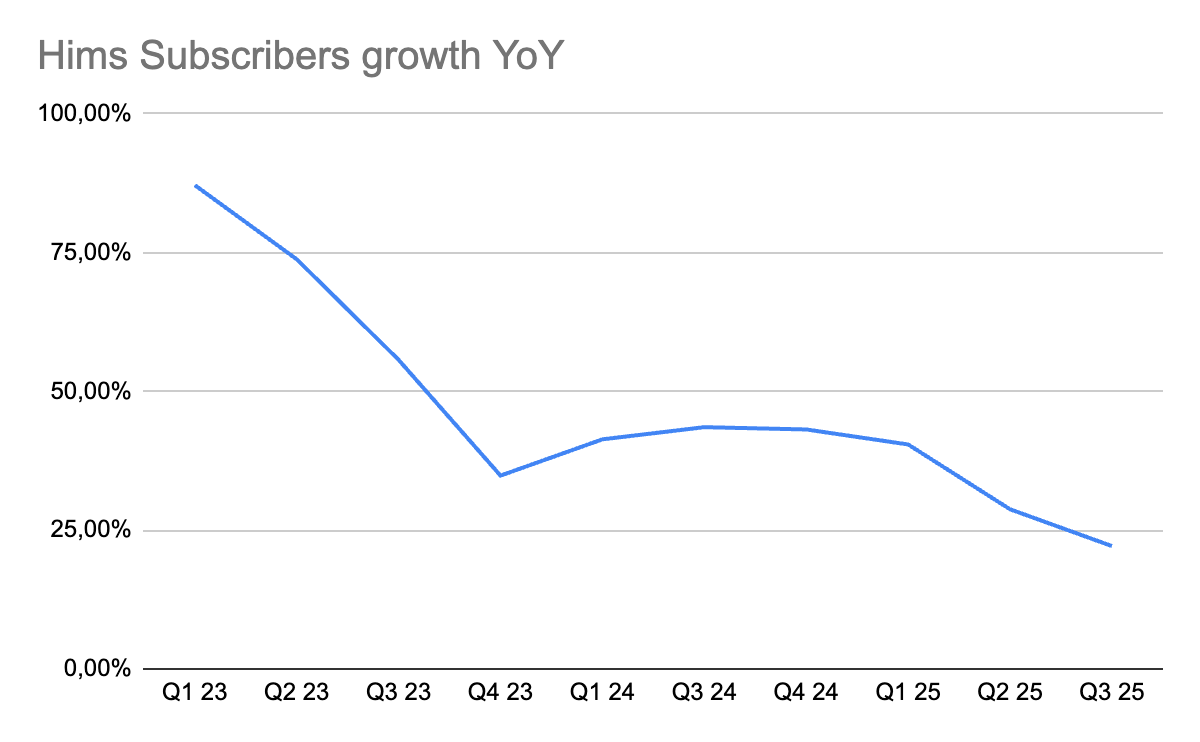
The main KPI I will be watching religiously for the next three quarters is subscriber growth. If it re-accelerates, the network effect story I just laid out goes from “possible” to “inevitable.” And the moat becomes unbridgeable.
And I’m perfectly fine if they have to compress margins for a few quarters to buy that growth. The long-term prize is too big.
Like the graphs and my analysis? Check out my “Tools I Trust & Use” page to see what I use—and grab ‘em via my links to support my work!
As of today, Hims remains ~18% of my portfolio — my second-largest position after Lemonade (my highest-conviction name).
I’m still here.
I still trust Andrew.
And I still think most people have no idea what is coming.
As always, here is the “Deep Dive To Date” (DDTD), that is how the stock is performing since my initial deep dive on the February 8th 2025, when the stock price was $42.54.
-8% DDTDSee you in the next update!
The content of this analysis is for entertainment and informational purposes only and should not be considered financial or investment advice. Please conduct your own thorough research and due diligence before making any investment decisions and consult with a professional if needed.
Thanks for writing this, it clarifies a lot. This network effect idea for healthcare is truly game-changing if it scales, but how do they handle the inherent privacy issues with such sensitiv data?
The data moat angle is super interesting, but I wonder if the regulatory environment will let them actually leverage that advantage. Health data is notoriously hard to monetize even when you own it, and every privacy law seems to get stricter. Still, the in-house compounding facility gives them a real structural edge that most competitors can't copy.