


If you haven’t read my original deep dive on Oddity, I recommend doing so before reviewing this update. It’s essential reading for a thorough understanding of the company.
Additionally, since Oddity remains relatively undercovered by analysts, I’d encourage you to read my recent articles for a deeper understanding of the business and its current trajectory
Oran Holtzman, CEO and founder of the company, made it clear:
METHODIQ is starting in dermatology, but our long-term goal is to expand into new medical domains in the future, and these are in development as we speak.
What is this if not a declaration of war to Hims and Hers?
Our launch into dermatology takes on a massive problem. Industry data shows that nearly 50 million Americans suffer from acne, nearly 30 million from hyperpigmentation and more than 30 million from eczema, and many of them are unsatisfied with the current options on the market. Drugstore products lack efficacy and personalization, going to a dermatologist is a high friction and the standard of care for these conditions has declined.
Does the word “personalization” remind you of something?
METHODIQ is expected to feature a huge line of 28 prescription and nonprescription products, which combine for more than 100 unique treatment combinations or precision personalization. We have aimed to optimize these products to balance between maximizing efficacy and minimizing side effects.
Does the phrase “minimizing side effects” ring a bell?
METHODIQ operates as a comprehensive, technology-driven skincare platform designed to address common conditions like acne, dark spots/hyperpigmentation, and eczema, providing users with personalized, continuous care through a combination of digital tools, clinician oversight, and targeted treatments.
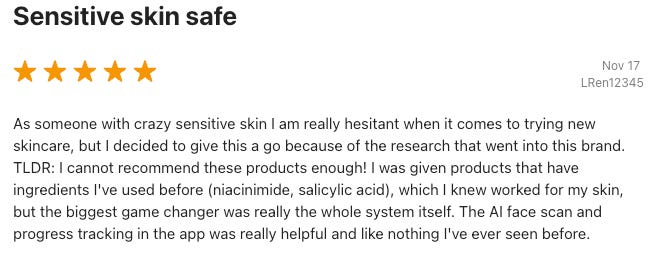
The process begins with an intake and onboarding funnel in the METHODIQ app, where users provide contextual details via targeted questions on demographics, hormonal factors, medical history, and similar inputs—mirroring what a clinician might assess in an office visit. Simultaneously, the platform’s proprietary vision tools, developed in collaboration with dermatologists, analyze visible skin features through user-submitted photos or scans, quantifying signals such as the number and intensity of lesions, breakouts, pigmentation, and other markers to generate actionable insights.
Indeed, METHODIQ built up on the experience and data gained so far thanks to the other two brands, Il Makiage and Spoiled Child.
These vision models were built drawing on more than 1 million image of real individual with no facial skin condition, which we believe is the largest image data set of its kind and was curated from over 13 million facial images in ODDITY’s database.
This aggregated data is seamlessly integrated with third-party provider systems and shared with a network of board-certified physicians (currently all physicians, with potential future expansion to nurse practitioners and other practitioners) for review. The clinicians use these “strong signals” to inform treatment decisions, prescribing a tailored regimen that may include non-prescription options like oral and topical supplements, medical-grade makeup for concealing issues such as whiteheads, or prescription formulations via compounding pharmacies.
In the near term, METHODIQ plans to launch at least four products in 2026 featuring proprietary molecules from ODDITY LABS, specifically targeting conditions like dark spots, papular scarring, eczema, and skin filaments.
Post-treatment, METHODIQ emphasizes ongoing monitoring and support through its innovative tracking app, which facilitates weekly check-ins. Here, the vision technology again plays a central role by quantifying progress—measuring changes in skin metrics over time—and automatically updating the assigned clinician with real-time data. Users can also chat directly with their clinician for feedback, adjustments, and motivation, fostering confidence, adherence to the regimen (compliance), and optimal outcomes (success).
This clinician-user loop, powered by AI-enhanced integrations and proprietary datasets, differentiates METHODIQ by bridging virtual diagnostics, prescription access, and sustained care, ultimately aiming to serve the vast U.S. market of around 50 million with acne, 30 million with hyperpigmentation, and 30 million with eczema—many of whom already engage with ODDITY’s existing brands like IL MAKIAGE for coverage solutions. While some prescription elements introduce additional costs (e.g., via third-party networks and pharmacies), the model prioritizes mostly non-prescription pathways for broader accessibility and efficiency, with opportunities for in-house scaling in the future.
Like the graphs and my analysis? Check out my “Tools I Trust” page to see what I use—and grab ‘em via my links to support my work!
Conclusion
Oddity Tech marked another strong quarter, ahead of the guidance, growing 24% YoY, with $781M revenue LTM (as of Q3), raised the guidance for Q4 and successfully launched the new brand METHODIQ, about which users look to be enthusiastic.
On top of that, ODDITY LABS is finally starting to bear fruit, with at least 8 products featuring proprietary molecules planned for market in 2026 across their brands.
As an investor, I don’t know what to ask more than this. Just waiting for Wall Street and retail investor to wake up to Oddity.
As always, here is the “Deep Dive To Date” (DDTD), that is how the stock is performing since my initial deep dive on the July 16th 2024, when the price was $44.24.
+0% DDTDSee you in the next update!
The content of this analysis is for entertainment and informational purposes only and should not be considered financial or investment advice. Please conduct your own thorough research and due diligence before making any investment decisions and consult with a professional if needed.