


On November 10th, $HIMS dropped 17% in a day.
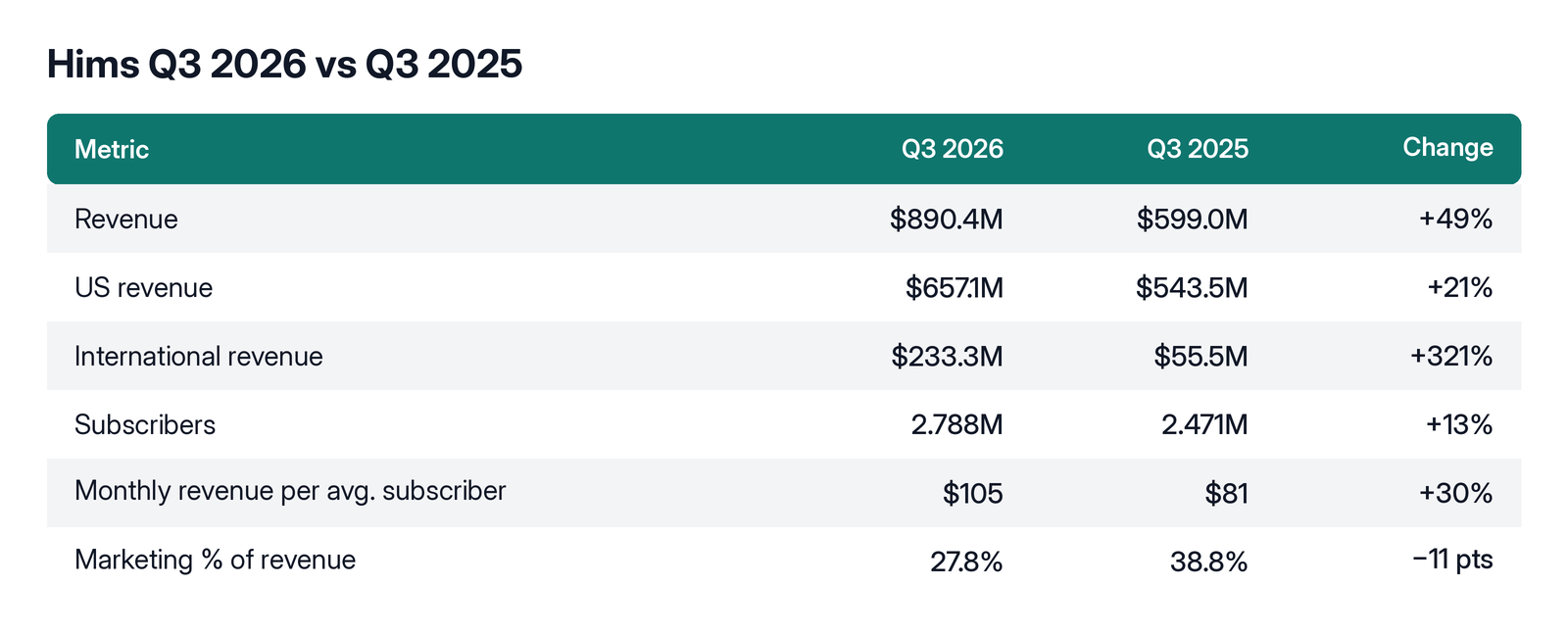
Subscribers went down by 103K quarter over quarter, to 2.788M. First sequential drop in the three years of data I track.
The management chose it (this is what they claim).
My thesis hasn’t changed: in healthcare, whoever owns the customer relationship wins. Hims has to get more customers, keep them longer, and sell them more things over time. Q3 was a quarter where they traded the first one to build the other two.
1. The trade: subscribers now, platform later
This is how Andrew Dudum explained the drop:
The weight loss business has undergone structural changes in the last few quarters, and we’ve intentionally pulled back on marketing spend in order to execute on 3 things in advance of the new year.
The three things: get ready to win metabolic health with Lilly next to Novo, invest aggressively in the UK, Germany and Australia, and make room for the new specialties coming in 2027. Then:
Each of these choices trades near-term subscriber growth for a stronger position in the years that follow. That’s a trade we will make every time.
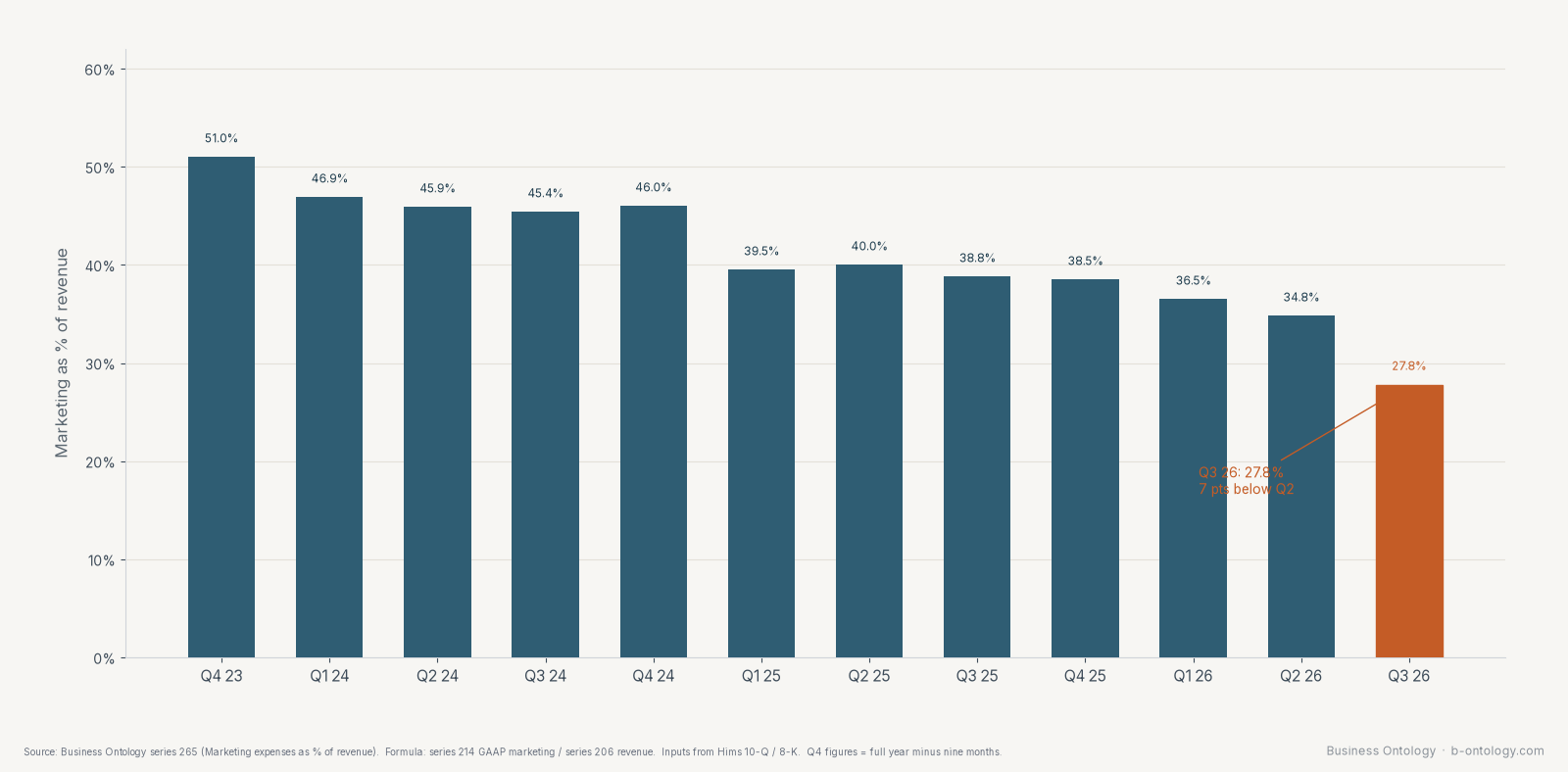
You can see the trade in the P&L. Marketing was 27.8% of revenue, the lowest in three years, from 34.8% in Q2 and 38.8% a year ago.
And US revenue still accelerated, from +16% in Q2 to +21%, with less marketing behind it.
This sounds reasonable and strategic to me. When you run a D2C you must be able to make this kind of trade-off. In the first half of the year Hims posted what Yemi Okupe called “record level subscriber additions” in weight loss. I see no reason to believe they couldn’t have kept buying subscribers into this demand if they wanted to.
They didn’t want to. Not before January, when weight loss demand peaks and the Lilly assortment is live.
Okupe already warned Q4 “may lead to an additional quarter of subscriber count headwinds.” So don’t expect the number to turn in the next print.
2. The platform: fewer customers, worth more
Dudum opened the call with the line that is basically my thesis:
In health care, whoever owns the customer relationship wins. That’s easy to say and very hard to do.
And a bit later: “That is a multiplier model, not a transactional one.”
The numbers are going that way. Monthly revenue per average subscriber hit $105, from $92 in Q2 and $81 a year ago. Fewer subscribers, each one worth more.
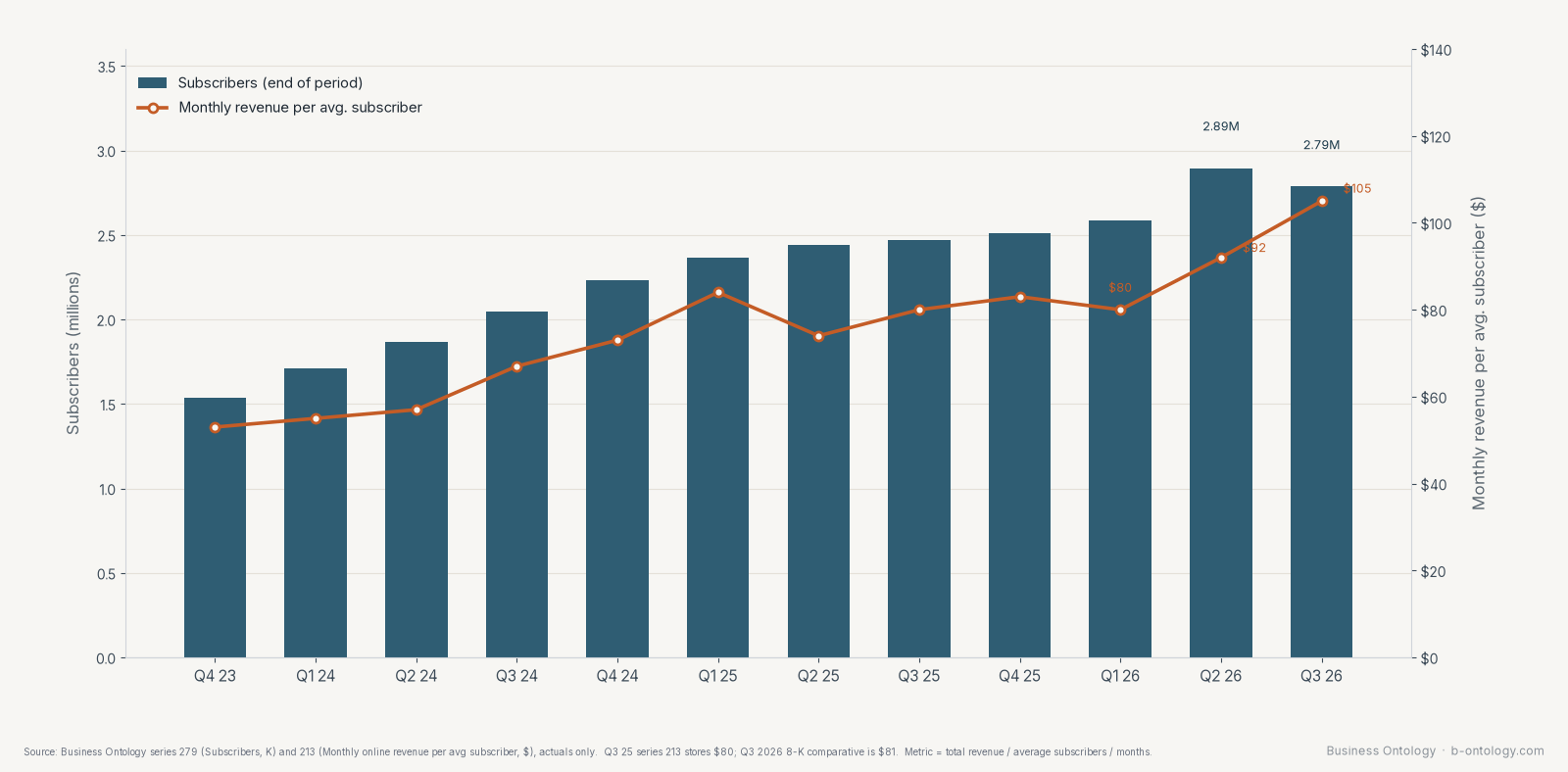
Part of that is mix: branded GLP-1s carry higher price points, and Eucalyptus had its first full quarter. But the direction is what Hims is building for. In the Q1 deck they said Hims subscribers addressing multiple conditions grew more than 5x in two years. And on this call they listed the scorecard they want to be judged on: number of subscribers, retention, and subscribers treated for 2 or more conditions.
That’s the right scorecard.
Look at what got added in a single quarter. Lilly joined Novo on the platform: Foundayo from $149 a month, Zepbound from $299. Injectable and oral testosterone, their first controlled substances. Peptides+ launching this month, with blood testing, from their own US peptide plant. Behind all of it, more than 1 million square feet of their own pharmacies and labs.
Hims is becoming the distribution layer for Big Pharma. The bigger it gets, the higher the FOMO to get in.
The peptides membership is the part I like most. Dudum:
We’re going to be bringing this offering to market with a membership dynamic that really, over time, incentivizes and allows for more whole life care. And that means multiple treatments across multiple therapies...
Peptides will make Hims much more sticky and push LTV up. LTV / CAC is all this game is about. To be fair, management says peptides won’t be material to Q4 revenue. This is a 2027 story.
Hims still claims 85%+ long-term retention and a payback under one year in its deck. Those are standing claims, not Q3 measurements, and I’d love to see them updated next quarter with the 2027 outlook.
3. AI: engagement first, then scale
CTO Mo ElShenawy:
Customers with access to the new experience are sending 4x as many messages on the platform, helping them stay more connected to their care team and on track with their treatment.
The AI-native experience reached 70% of weight loss subscribers at quarter end, with nearly 100% expected before year end. Then hair, sexual health and testosterone.
As a D2C, before you scale new features you want to be sure they’re robust. This is a good signal.
And it reminds me of what $LMND did with its LAE ratio. Mo said AI is driving “a reduction in non-clinical tasks handled by human, even as daily customer touch points expand dramatically.” More touch points, less human work per customer.
I track Hims on Trustpilot. Today it’s 2.9. Hers is 3.3. It’s a noisy metric, people mostly review when they’re angry (I do it myself). But from now on, I expect it to go up.
4. International: about to move the needle
International was $233M of $890M revenue. 26%.
About $135M came from Eucalyptus. The rest grew nearly 80% year over year. Management raised the 2026 international target to at least $650M, from $600M, and expects a $1B run rate in 2027.
Either international growth slows down, or it moves the needle in a quarter or two. The Hims and Hers brands just launched in Germany and Australia. Management warned that consolidating the brands means “some near-term subscriber volatility.” That’s part of the Q3 drop too.
5. And Ro?
The bear chart going around: TickerTrends shows Hims’ share of US consumer interest in weight loss providers at 18.5% for August 9 to November 7, from 53.5% a year earlier. Ro, LillyDirect and NovoCare took the rest.
Ro is a serious competitor. I wish it were public, so we could compare properly. It isn’t. No disclosed revenue, no subscribers, no margins.
What we know is the strategy. Ro launched its GLP-1 Body Program in January 2023 and has gone all in on weight loss, with Serena Williams in a Super Bowl ad this year.
The drug price isn’t the difference. Lilly sells Foundayo at the same self-pay price on both platforms, from $149 a month.
To be honest, Ro scores better on Trustpilot: 3.9 versus 2.9 for Hims. On the App Store they’re both at 4.8, Hims on about 98K ratings, Ro on about 13.5K.
My bet is that Hims vs. Ro will play out like $LMND vs. $ROOT. Root was ahead on revenue for years. In Q3 2026 Root did $381.3M, down 1.7%. Lemonade did $336M, up 73%. It’s catching up quickly.
Ro is betting the house on GLP-1s, so it grows fast. Hims is playing the long game, a platform that maximizes retention and cross-selling. It takes longer. I think it plays out bigger.
Conclusion
Hims is one of the most asymmetric plays in the market. In 5 years it could go up 20 times or more if they execute, but the risk of losing your capital is surely very high.
The market wanted subscribers. It’ll get them in Q1, or I’m wrong.
As always, here is the “Deep Dive To Date” (DDTD), that is, how the stock has performed since my initial deep dive on February 8th, 2025, when the stock price was $42.54.
-54% DDTDIf you want access to:
My portfolio
all my trades in real time
my price targets and how I calculate them
Business Ontology content
Join the Business Ontology Community
My price targets will be shared in the Telegram Group and explained on my Youtube channel.
I share my thoughts on X.
I can be and will be (hopefully not often) WRONG. This is just my personal strategy—NOT FINANCIAL ADVICE. I don’t know your financial or life situation well enough to give any recommendations. Please do your own due diligence and research. Don’t be LAZY.
Be the architect of your own destiny.
Ciao
Lorenzo