


In November 2024, Lemonade unveiled its plan to grow from $1 billion to $10 billion in In-Force Premium (IFP) at its Investor Day event—and the main driver of such growth will be car insurance.
Together with the excitement of a company that’s delivering results from every angle and a clear path—for us enlightened ones—to becoming millionaires, there’s a small voice that pipes up from time to time with a silly question.
What happens when cars become autonomous and crashes are reduced close to zero? Will there still be a need for car insurance, or will that drive Lemonade out of business? Why wouldn’t Tesla want to take the whole market, and why wouldn’t it be able to do so given its data advantage? After all, Tesla knows everything about its cars.
Tesla’s Full Self-Driving (FSD) tech, powered by vast telemetry data, could slash accidents by 90%+, shifting liability to manufacturers and threatening personal auto insurance.
First of all, let’s address what car insurance may become.
As crash risks approach zero with fully autonomous vehicles, car insurance premiums will plummet as claims losses compress dramatically. Prices will converge toward bare-bones marketing and administrative costs, with the most efficient insurer emerging as the winner.
Additionally, lower premiums mean insurers collect less float to invest—further squeezing margins. These dynamics could drive many incumbents out of business. Single-product auto insurers like $ROOT may also struggle long-term, as they rely entirely on car premiums and lack both the scale to aggressively acquire market share and the ability to leverage a multi-product strategy (cross-sell).
In this scenario, Lemonade emerges as a winner, since—according to my thesis—it will soon become the most efficient insurer in the world at acquiring and onboarding customers, and at managing claims.
Costs for Lemonade will converge to the cost of marketing—and for cars, it may even be lower than that.
This is what Daniel Schreiber, Co-founder and CEO of Lemonade, declared during the last earnings call:
All our products and regions contributed to this dynamic of accelerating top line and improving profitability, though it is worth spotlighting car, which saw 40% growth with more than half of that coming from existing Lemonade customers—essentially CAC-less acquisition.
You got it: 20% YoY car growth came with zero cost of acquisition.
If you can’t immediately grasp what I mean when I say Lemonade is poised to be the most efficient insurer on earth—and how they can achieve that—I recommend you go read my previous articles and the original deep dive. Or, to save time, you may want to watch the video of me recently explaining my thesis in simple terms, hosted on the Antonio Linares’ Podcast.
In other words, what I’m saying is that car insurance prices will get ridiculously low, margins crazy thin, and one of the few able to thrive under those circumstances will be Lemonade—which will therefore enjoy low margins but high volume as it takes most of the market.
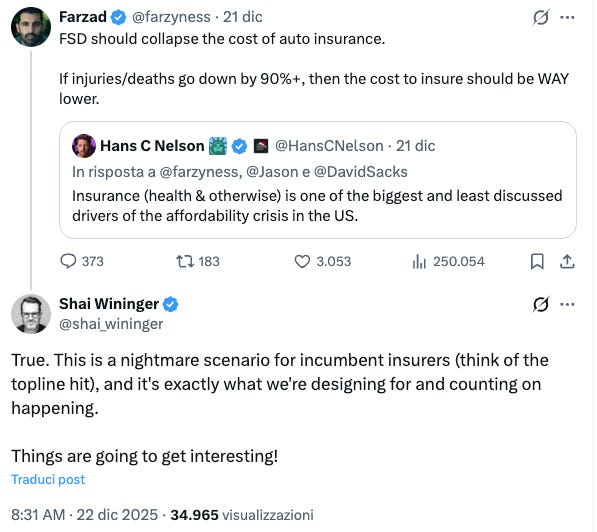
Shai Wininger, the other co-founder, is exactly confirming my thesis with his X post on December 22—and even more importantly, he’s confirming that Lemonade is not only designing itself exactly for the described (apparently catastrophic) scenario but is actually embracing it and trying to be early.
As always happens with an innovator’s dilemma, when incumbents realize what’s happening, it will be too late. This is so obvious if you think that the vast majority of people are still unaware that vehicle autonomy has been basically solved by Tesla—and, even worse, those who are aware, including expert analysts, are still in the denial phase, pretending Tesla’s unsupervised FSD isn’t happening.
Finally, regarding Tesla’s decision not to dominate the entire insurance market for its privately owned vehicles (a different story from robotaxis, where Tesla is likely to self-insure its fleet), several factors are at play.
However, the most compelling reason appears to be strategic focus: Tesla is pursuing extraordinarily high profit margins through FSD, robotaxis, and Optimus, where insurance—a low-margin business—would dilute overall profitability and add significant complexity for minimal upside. In essence, it’s a lot of regulatory and operational hassle for negligible long-term gains.
That said, Tesla does need its own insurance capability, particularly in the early stages of unsupervised FSD, to manage manufacturer liability. In traditional human-driven vehicles, primary responsibility falls on the driver. But as autonomy advances (especially to unsupervised levels), liability shifts increasingly to the manufacturer for issues like software glitches, design defects, sensor failures, or inadequate validation. Traditional insurers are often reluctant to cover this unpredictable, potentially explosive risk, which could block widespread FSD adoption if external providers refuse policies or demand prohibitive premiums. This is why Tesla has built internal insurance operations—to ensure a smooth path forward without external roadblocks.
However, recent developments suggest openness to partnerships: Lemonade has integrated directly with Tesla vehicles in several states and publicly offered to insure FSD miles for “almost free,” citing the technology’s superior safety. If viable third-party options like this emerge (with stable, low rates), there’s little reason for Tesla to exclude them—especially for private owners.
If I were Tesla, I’d price my own insurance competitively: low enough to pressure non-FSD competitors (potentially driving them out of relevance) but high enough to allow efficient providers like Lemonade to profit while Tesla earns some margin too. Maintaining multiple insurers in the ecosystem avoids creating a single point of failure, fosters competition for better rates and service, and reduces Tesla’s exposure to full-market risk. This balanced approach supports rapid FSD scaling without overcommitting to a commoditized insurance business.
The content of this analysis is for entertainment and informational purposes only and should not be considered financial or investment advice. Please conduct your own thorough research and due diligence before making any investment decisions and consult with a professional if needed.