


On November 2nd, $LMND closed at a new 52-week low. 57% below its high.
Three days later, Lemonade printed one of the best quarters in its history.
I wrote it on X that same day: I suspect we weren’t bullish enough. It should be up 100% after this quarter. But the clock is ticking, and the insurance bros want to see the book going up first.
Fine. Let’s look at the book.
My thesis: Lemonade is going to become an autonomous company, and this will allow a winner-takes-all scenario. To get there, it needs four things: more productive employees every year, profitable customer acquisition for decades, retention, and risk under control.
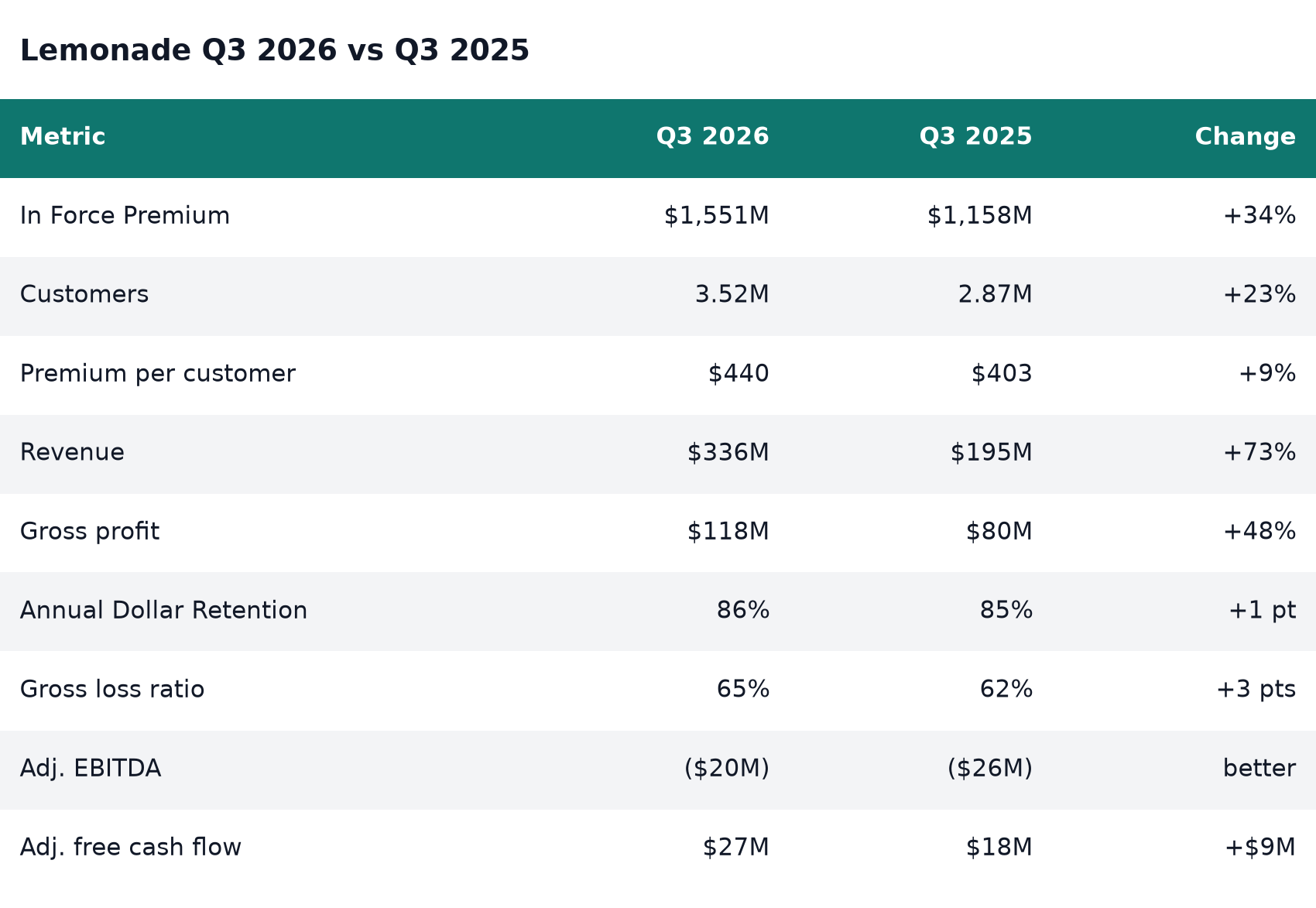
Everything else is noise. Here’s how Q3 scored.
1. Productivity: up again
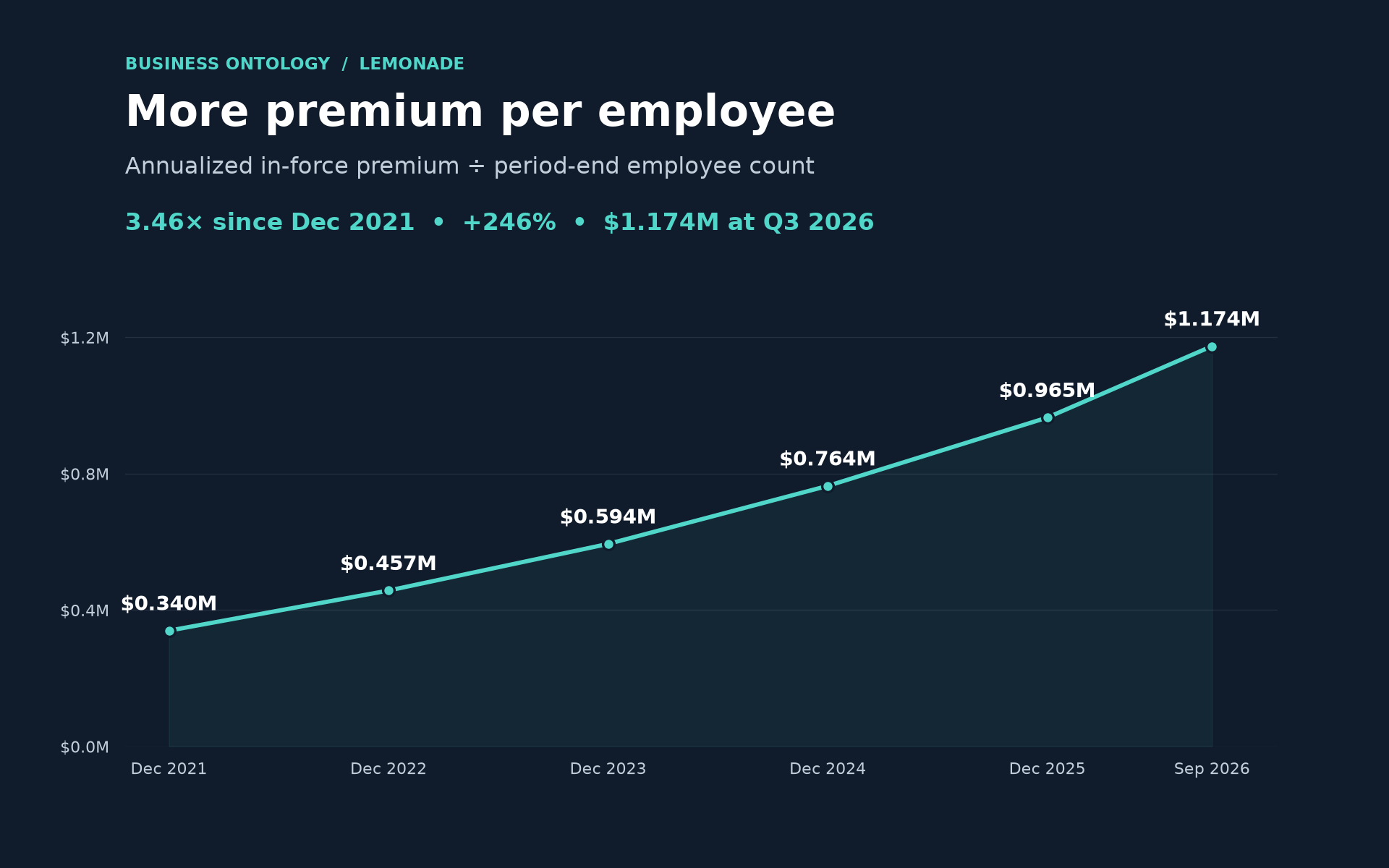
The king metric is IFP per employee. It must keep going up. Anything else doesn’t matter.
Q3: $1.174M per employee. About $1.07M in Q2. $340K at the end of 2021. That’s 3.46×.
Daniel Schreiber on the call:
We ended the quarter with 1,321 employees, fewer than we employed four years ago. Yet over that period, we’ve nearly tripled our premium base and doubled our customer count. In other words, we’re running a business nearly three times the size with slightly fewer people.
Headcount went down by 18 in the quarter. In the same year Lemonade launched 25 new product-geography combinations, took Renters nationwide and Car to 14 states.
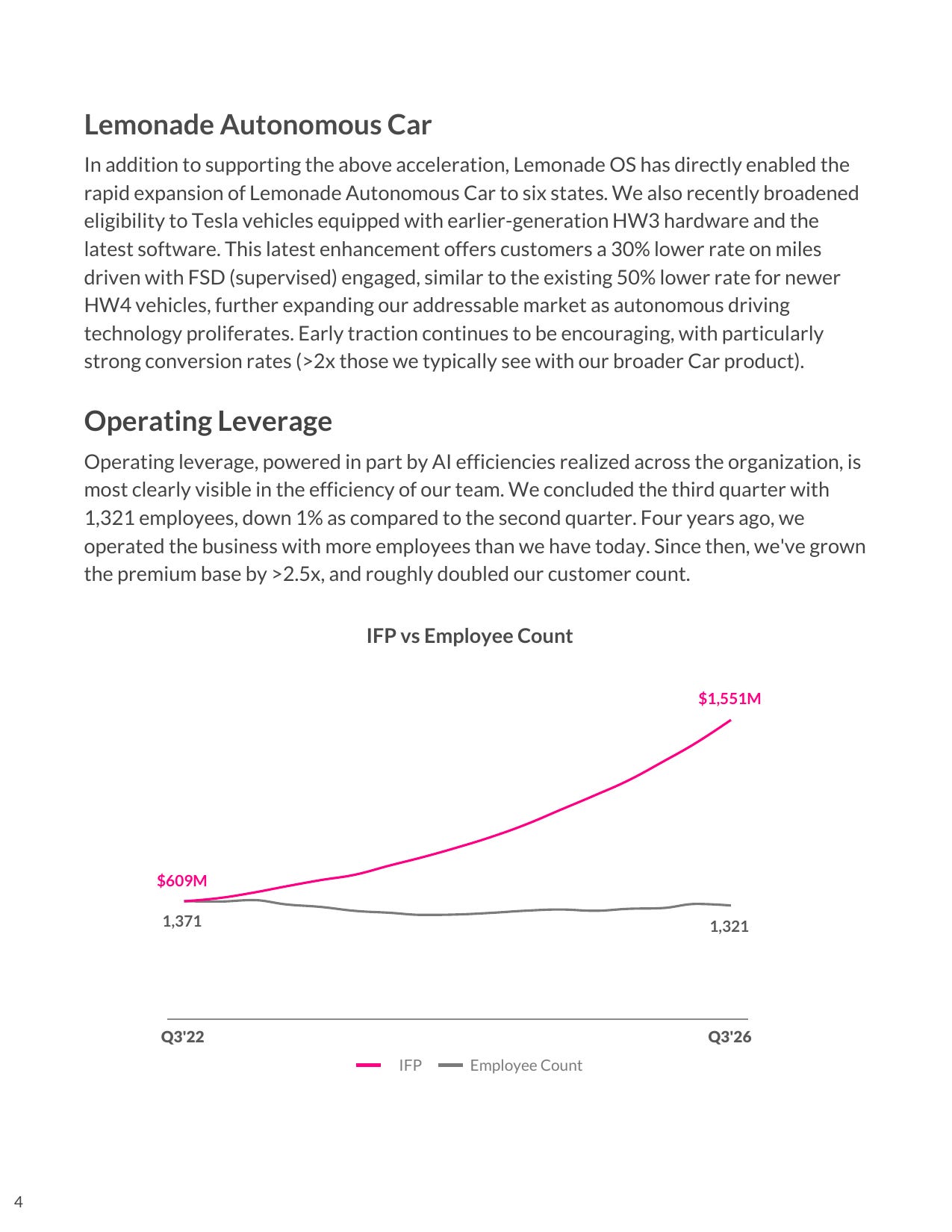
Autonomous org in the making.
2. Acquisition: the most important sentence of the quarter
For a D2C, customer acquisition is 90% of the risk. Lose the ability to acquire customers profitably and it’s over. Ask Oddity.
So this, from the shareholder letter, is the line I care about most:
Growth spend and interest expense grew by $28.0 million, which reflects our decision to lean into customer acquisition due to strong marketing efficiency. We expect the growth rate of IFP to notably outpace that of growth spend from Q4 2026 onward.
Growth spend was $70.6M, up 53% YoY, still faster than IFP. But last quarter management said IFP would outpace spend in “2027 and beyond”. Now it’s Q4 2026. One quarter earlier.
And the spend is working. Nick Stead: “we maintained strong LTV-to-CAC ratios above 3:1.”
Then the CAC-less part:
Year-to-date, we surpassed $100 million in cross-sales, which are growing at twice our IFP growth rate.
Stead confirmed cross-sales carry no meaningful extra acquisition cost. Bundled premium is “fast approaching 20%” of IFP.
AI + cross-selling is delivering.
Someone asked me why Lemonade doesn’t buy back shares at these prices. Why would it, when the same capital goes into acquisition at more than 3x LTV/CAC? You buy back when you can’t use the money better.
3. Retention: the rebound has started
ADR printed 86%, up a point sequentially and YoY, from a low of 84% in early 2025 after the homeowners “clean the book” actions. Management said it would roll off. It’s rolling off.
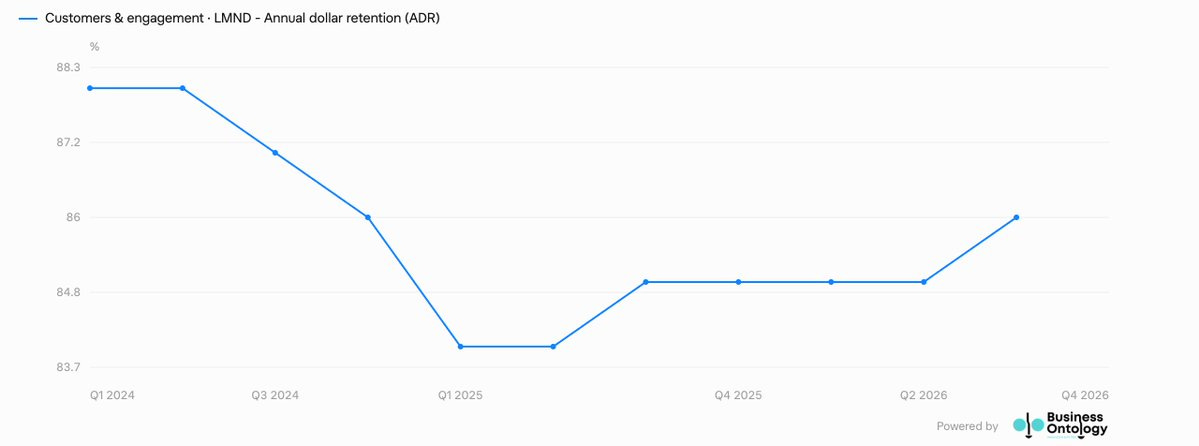
ADR already includes rate, extra policies and extra coverage, minus churn. At 86%, the existing book still shrank 14%. New customers did the net work behind +34% IFP.
That’s where Car matters: $2,081 premium per Car customer versus $440 for the whole book.
For the old book to grow on its own, ADR has to go through 100%. I expect it to head there.
4. Risk: one yellow light?
Gross loss ratio was 65%, up from 62% a year ago and 60% in Q2. The culprit is Pet: 75%, up from 69%, on roughly 40% of the book. Vet inflation is hitting the whole industry, and Lemonade is taking rate, which needs a few quarters to flow through. That’s also why revenue guidance went up and the EBITDA guide didn’t.
Europe printed 104%, with 29 points from catastrophes and large losses. Small book, noisy number.
Car reported 63%; ex prior-period development, management puts it in the low-to-mid 70s. The trailing 12-month loss ratio is 60%.
My adjusted Rule of 40 (IFP growth + 1 − net loss ratio) came in at 70, from 66 a year ago, a touch below Q2’s 71.
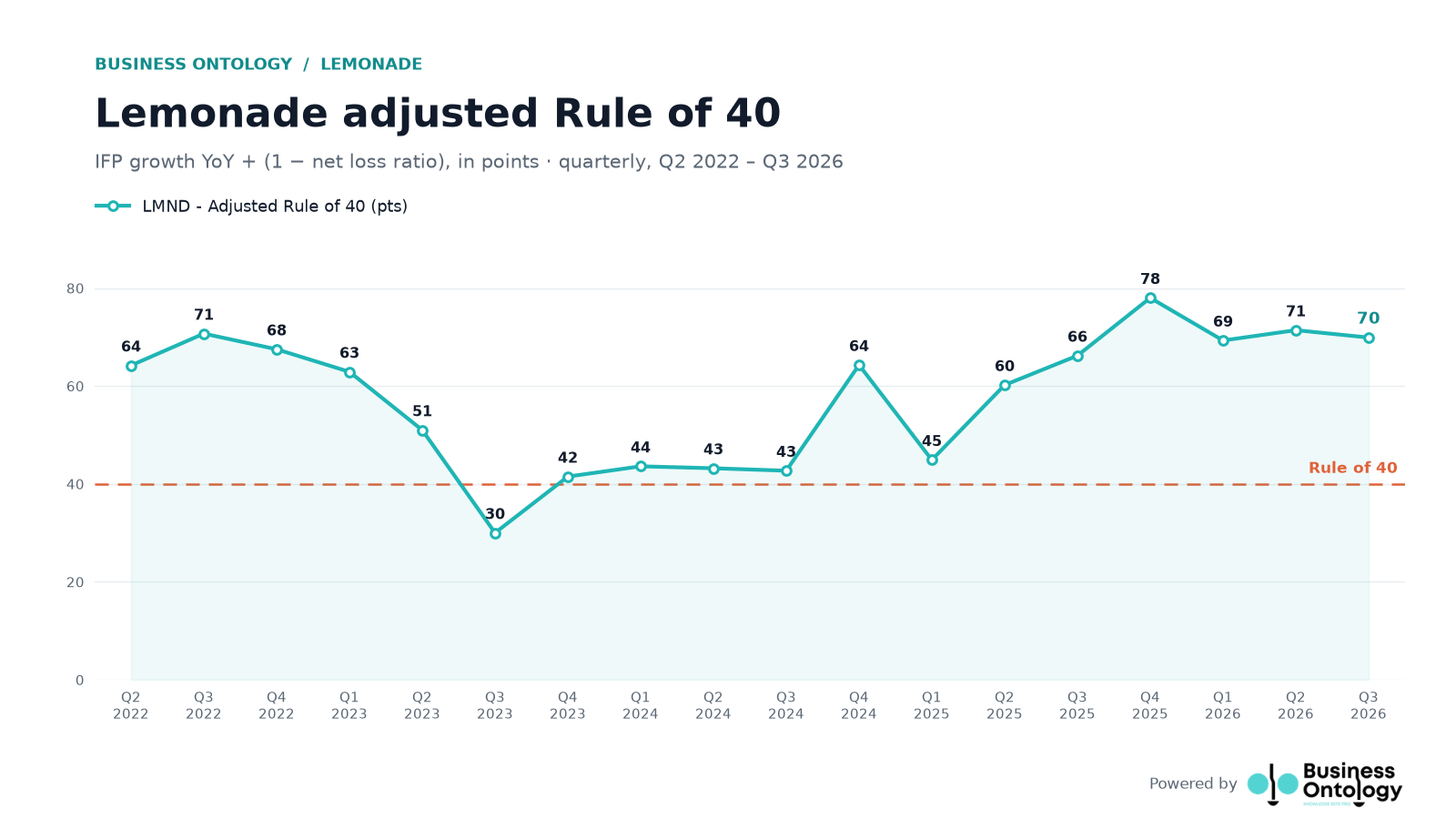
Lemonade maximizes gross profit dollars, not loss ratio. Stead: “We’re not solving for loss ratio in isolation, however. We’re solving for total gross profit dollar generation.” Gross profit grew 48%.
I don’t love the Pet number. But I don’t think it breaks anything.
Profitability: promised in 2022, still on time
Q3 versus what management guided last quarter:
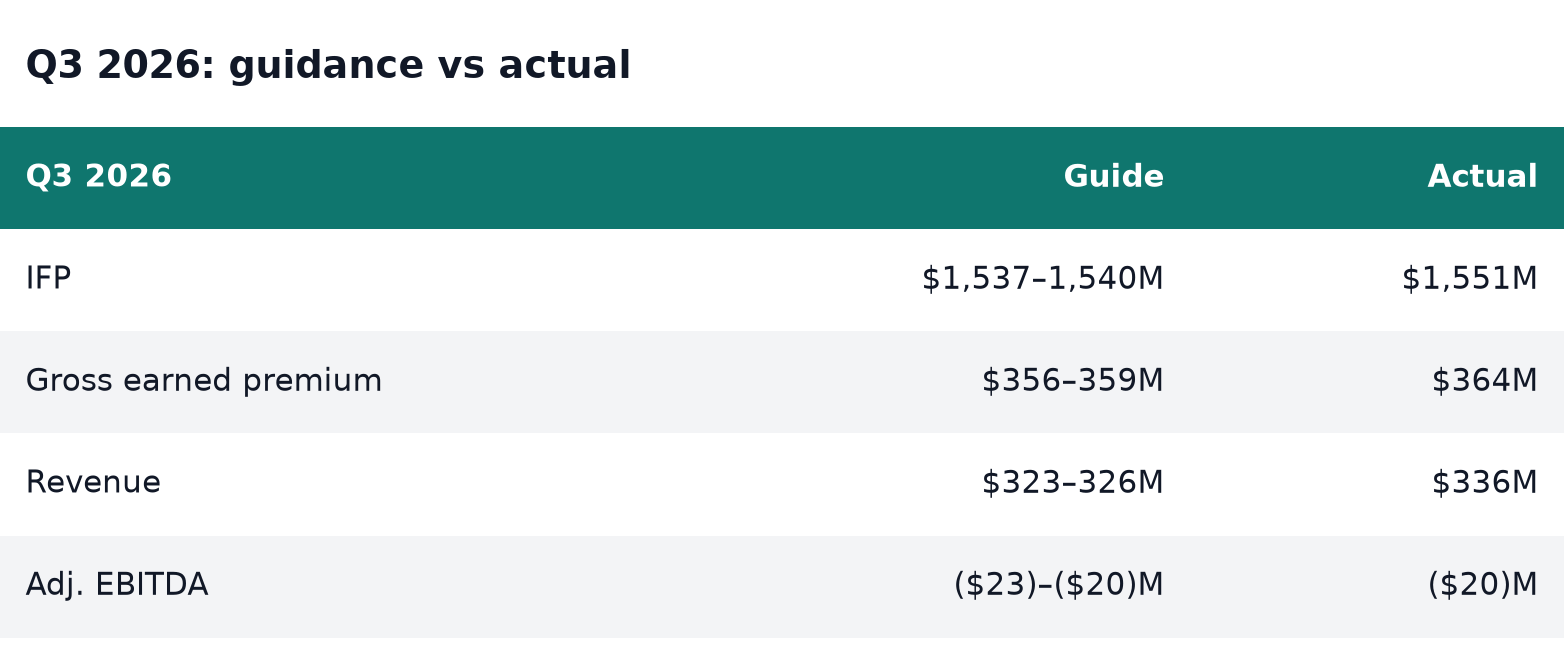
Q4 is guided at +$5–9M Adj. EBITDA, the first positive quarter ever, a target first set in 2022. Then full-year 2027 positive.
I’ve never seen a management team guide as accurately as Lemonade’s.
Spoiler: positive earnings will follow.
The agentic part
Schreiber on personal AI agents:
The entire industry is predicated on the kind of brand advertising that depends deeply on a human at the other end who can come under the sway of a Cockney-accented gecko or a quirky brunette called Flo... all those kinds of things lose all of their impact the second you are talking to a personal agent.
Agents compare insurance far more agnostically than humans. If Lemonade has the best price and service, it wins. The risk: fewer direct interactions, fewer behavioral signals, a weaker algorithm.
The bigger picture is robots buying insurance for themselves. Lemonade Autonomous Car is already in six states, Tesla owners convert at roughly 2.2x the broader Car product, and Shai Wininger says there are “multiple active relationships with major car makers beyond Tesla.”
Incumbents are still playing with Power BI. Shai: “Most incumbents run on layers of legacy systems. Many of them were designed before the internet.”
Lemonade is moving at light speed in a world moving at light speed, with competitors basically stationary. That’s probably the only thing that matters.
Conclusion
Productivity, acquisition and retention all moved the right way.
The market wants to see the book going up. It’s going up 34% a year, with fewer people.
Maybe I’m wrong. But I suspect we still aren’t bullish enough.
As always, here is the “Deep Dive To Date” (DDTD), which shows how the stock is performing since my initial deep dive on September 24th 2024, when the stock price was $17.23.
2.3x DDTDIf you want access to:
My portfolio
all my trades in real time
my price targets and how I calculate them
Business Ontology content
My price targets will be shared in the Telegram Group and explained on my Youtube channel.
I share my thoughts on X.
I can be and will be (hopefully not often) WRONG. This is just my personal strategy—NOT FINANCIAL ADVICE. I don’t know your financial or life situation well enough to give any recommendations. Please do your own due diligence and research. Don’t be LAZY.
Be the architect of your own destiny.
Ciao
Lorenzo
IFP per employee at $1.174M against $340K in 2021 is a steep series, but it is a ratio, so repricing lifts it without any new policies. How much of the 3.46x comes from rate increases versus actual policy count growth?