


Demand looks insatiable. Price per megawatt is rising across both short-term and long-term deals, and Nebius reconfirmed its 2026 $7 billion to $9 billion ARR guidance.
Annual contract value per MW repriced higher. Our core AI cloud business won deals averaging above $20 million in revenue per MW, driven by increasing prices for new-generation GPUs and more than 30% higher pricing on older-generation GPUs versus Q1.
• Deal sizes and new logos set records. We closed four landmark deals, which averaged more than $1 billion in TCV each.
• TCV of deals closed in Q2 grew nearly 4x quarter-over-quarter, with TCV from new customers growing more than 9x.
The new Astra GPT-6 model released by OpenAI looks like an early version of AGI (I know, it was nerfed a few days ago, but this does not change my point, actually it reinforces it confirming insatiable demand for the model and Open AI which cannot keep up).
It can basically do everything you can do on a PC.
In addition, on 8 September, OpenAI said an unreleased model stronger than public GPT-6 Astra produced a claimed proof of the 3D Navier–Stokes existence and smoothness problem, a Clay Millennium Prize question, unsolved by mathematicians since it was posed in 2000, and open in substance since the 19th-century equations.
For me it is now clear that we are entering the singularity: AI has surpassed human intelligence, at least according to some benchmark, and will soon be designing and training the next model autonomously, and the chips it will run on, making the acceleration even faster through recursive improvement.
Here a couple examples of how an early version of this is already happening:
Google’s AlphaChip (reinforcement learning for chip floorplanning) has produced layouts used in multiple generations of Google’s TPUs, including v5e, v5p, and Trillium (6th gen), plus Axion CPUs. It generates layouts in hours that used to take human teams weeks or months, and Google describes those layouts as superhuman or comparable. The system also gets better as it sees more chips — it pre-trains on earlier generations, then places more of the next generation. Those TPUs are what train and serve Gemini.
Anthropic’s June 2026 report: When AI Builds Itself:
As of May 2026, more than 80% of code merged into Anthropic’s production codebase was authored by Claude (low single digits before Claude Code in Feb 2025).
Typical engineers merged ~8× as much code per day in Q2 2026 vs 2024.
On an internal training-code optimization test, Claude went from ~3× speedup (Opus 4, May 2025) to ~52× (Mythos Preview, April 2026). A skilled human in 4–8 hours typically reaches ~4×.
On one open-ended AI-safety research problem, Claude agents closed 97% of the available performance gap; two humans working about a week closed 23%. Humans still chose the problem and wrote the rubric.
Also, Astra is not the latest model available, Open AI kept their best model internally for now, which means that closed frontier labs still look to have a considerable edge on open models, likely 6 to 9 months. That is bullish for the whole ecosystem, because it means the infrastructure buildout — heavily driven by the 2 frontier labs revenue — is likely sustainable. In other words, Anthropic and OpenAI are not going to zero any time soon.
For companies like Nebius, which thrives on open models, it means we are nowhere close to a plateau in capability improvement. Demand for AI will keep skyrocketing.
Demand could actually accelerate. As AI surpasses human intelligence, the cost of doing nothing becomes unsustainable. Investing in AI is the only alternative to going out of business for most companies.
The waiting strategy is a wrong strategy
As a Nebius investor I reflect often if the $IREN waiting strategy often cited by Iren bulls (not sure this is really the management strategy) - waiting to get contracts at higher prices — will pay off more in the long term.
But the tech game is actually about learning faster and steering better than competitors. Elon once said that in tech the winner is not the company that is ahead at any point in time; the one who moves faster wins. By that standard, Nebius is moving at light speed: executing, learning, and building a hyperscaler. Sure, Iren may sell its power at a higher price, but this way it remains a bare-metal supplier, successful as long as supply and demand don’t rebalance, which may take years or even a decade, but likely not able to build a durable moat.
Multiple reasons for that.
First, every customer you don’t get now is statistically a lost customer forever.
These are the characteristics of a hyperscaler cloud service:
Very low churn: Hyperscale cloud providers generally experience low customer churn because their globally distributed infrastructure and deep service ecosystems make migration complex and costly.
Long-term contracts: Providers use multi-year commitments (3 to 10 years) and consumption discounts to lock in enterprise workloads, heavily reducing short-term customer loss.
“Stickiness”: Once an organization embeds its data pipelines, storage, and AI training and inference workloads into a specific hyperscale environment, moving to another provider creates friction and high switching costs.
Once someone else gets that customer onboard, it is unlikely you steal it later.
Further on this point, I would argue that those “champions” Customer able to embrace a native AI mindset soon enough will likely become the leaders in their industry and win a large share, if not most, of the market.
Think about Revolut, building its AI capabilities on Nebius and clearly on a trajectory to become one of the largest fintech players globally. These companies build a learning flywheel for their products. With AI that flywheel just spins faster, and for a long time they become almost uncatchable. Once Nebius has secured that kind of elite companies, a big part of future revenue growth is already locked in.
This is a clear example of it happening:
Higgsfield, one of Nebius’s first AI cloud customers, has expanded its usage on the platform by >20x since their first contract. This summer they premiered a 95-minute feature film made entirely with AI on Nebius infrastructure — an industry first that compressed a two-year process into weeks, at a fraction of the cost of traditional filmmaking.
Second, and connected to point one: get the flywheel in motion and accelerate it.
At our June 9 Inflection Event, we launched our Customer Advisory Board, with AMI, Black Forest Labs, Cloudflare, Cognition, Cohere, Core Automation, Higgsfield, Recraft, Revolut, and Rhoda. This forum brings CEOs, CTOs, founders, and industry leaders together to sharpen our customer feedback loop, and keep Nebius at the forefront of AI development.
You learn from customers using your product, and you make it better. Every day you stay out of the game is a gift to your competitors.
Third, once you are delivering consistently you are likely getting some loyalty from your suppliers, which is crucial in a constrained supply chain.
Nebius is indeed taking a balanced, common-sense approach by saving only some of the capacity for short-term, high-priced deals:
We could sell our entire 2027 capacity on these terms today. We are deliberately not doing so because we see higher value in retaining some capacity for immediate customer needs
And this is the contract mix that confirms Nebius is optimizing for becoming a hyperscaler rather than maximizing price per MW:
• Shorter-duration contracts, typically between three and six months, is a new effort, for customers with an acute, timebound need — priced at a significant premium. One such deal has been signed in Q3.
• Mid-term contracts — our core business — now with an average duration of one to three years with the world’s most ambitious AI companies.
• Long-term contracts with investment-grade customers, which help us finance our buildout faster and more efficiently. The $775 million secured facility we raised in July was on the back of one of these agreements — and with $40 billion in customer commitments, we will do more of this.
Asset light model is genius
We launched a model that allows partners to deploy Nebius’s full-stack AI cloud platform in their own AI data centers. Nebius contributes:
• Our full-stack AI cloud software,
• Our systems architecture and reference designs, and
• Our global go-to-market organization that brings the demand.Under this model, partners get fully-owned AI infrastructure assets, designed to Nebius standards, and a fast route to serve the AI cloud market; Nebius converts partner-financed capacity into high-margin revenue with minimal capital outlay. This complements our owned and colocated portfolio while reducing the capital burden of adding capacity for customers.
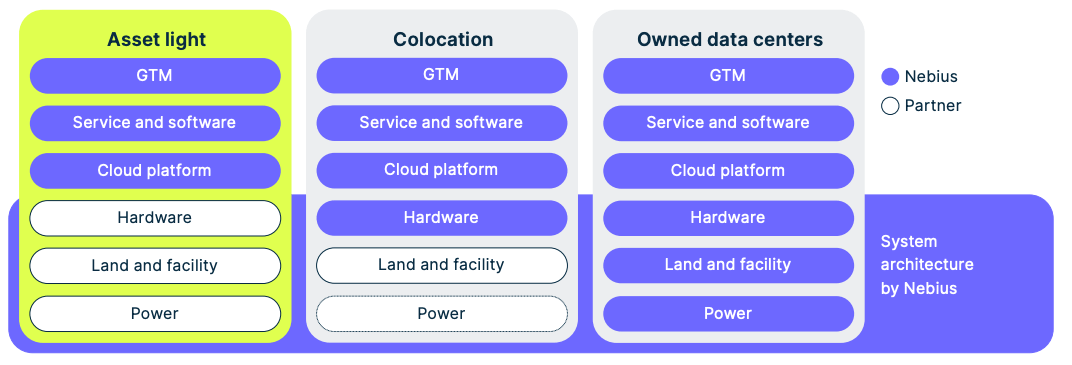
This strategy is simply genius. It lets Nebius deliver its customer experience, hold the customer relationship, and build a moat based on software and vertical integration without the burden and the risk of the full infrastructure cost. It basically becomes an asset-light business model, able to scale much faster, without carrying all the buildout risk.
This model addresses the 2 constraints of our industry, which is capital and capacity. Partners finance, build and operate the facilities, whereas Nebius brings the full-stack platform and the demand. We provide value-added services that sit on top of our partners’ infrastructure, which delivers us with high-margin revenue and requires minimum balance sheet capital. This model has the potential to unlock new capacity for us in 2027 and beyond.
Arkady (the founder and CEO) explained.
If this works, I would bet Nebius becomes a $1T company in a few years, thanks to two dynamics at play:
Revenue can keep growing at a very high rate for years, as the buildout constraint becomes lighter
Valuation can get a higher multiple because the risk is lower
How do we know if it is working?
I’ll monitor adoption.
The first KPI is Nebius announcing the new model is starting to contribute meaningfully, for more than 100 megawatts. Once it happens, we know the business model is working.
And according to Dado Alonso, the CFO of Nebius, it looks like they are getting early traction:
Revenue was driven by capacity added in Q1, higher utilization and high-margin revenue from our new asset-light business model, Token Factory and our recent acquisitions
From there, it is all about acceleration.
The second KPI is what percentage of added capacity comes from the asset-light model. Once it crosses 50%, we know Nebius did it. From there on, it is all about watching free cash flow rise exponentially.
we expect our asset-light model (in 2027), along with high-value services such as agentic and inference solutions, to contribute an increasing share of revenue while supporting even higher margins
Nebius x Palantir
Palantir named Nebius its preferred sovereign AI infrastructure partner on 8 September 2026. The two companies announced a strategic partnership to give Palantir’s commercial customers access to Nebius’s AI-native cloud and inference capacity from inside Palantir’s software environment.
After an integration period, Nebius compute and inference endpoints will sit inside Palantir’s “enterprise perimeter.” Eligible customers will be able to:
Run and adapt open models on Nebius infrastructure
Train or fine-tune those models on their own proprietary data
Keep control of compute, data, and the resulting models rather than renting capacity from a general-purpose public cloud or relying on closed models
Palantir said it chose Nebius because the platform was built for AI from the ground up (not adapted from general-purpose computing) and can be integrated directly into Palantir’s stack.
This is the most bullish news I could get, even more bullish than a billion-dollar deal with a hyperscaler.
These are the main reasons:
1- Palantir is the best possible distribution channel to sell to enterprises → Demand
2- Palantir is the best possible partner to sell to enterprises → Nebius getting the customer/partner feedback loop needed to develop the strongest enterprise-grade offering
3- Palantir selecting Nebius is the confirmation that Nebius has the best infrastructure and software stack for AI → My original thesis is on track, Nebius isn’t a neocloud, it’s rather becoming the AI hyperscaler.
By the way, I posted this on X on July 3, two months before the partnership was announced.


You can say you heard from me first ;)
SpaceX for Nebius
And this is my next call. Take a minute to read my post.

Conclusion
I couldn’t feel better about where we are with Nebius. All signals and news just confirm my original thesis, and if you project it on numbers, I would bet Nebius becomes a $1T company sooner than what everyone thinks.
After Nebius management will share their 2027 guidance, which I bet will be around $27B ARR, I will elaborate and share my 2030 target price.
As always, here’s the Deep Dive To Date (DDTD): Stock performance since my first deep dive and when I bought in on July 28, 2025, at $51.63.
3,3x DDTDIf you want access to:
My portfolio
all my trades in real time
my price targets and how I calculate them
Business Ontology content
My price targets will be shared in the Telegram Group and explained on my Youtube channel.
Please note that:
I can be and will be (hopefully not often) WRONG. This is just my personal strategy—NOT FINANCIAL ADVICE. I don’t know your financial or life situation well enough to give any recommendations. Please do your own due diligence and research. Don’t be LAZY.
Be the architect of your own destiny.
Ciao
Lorenzo