


On November 12th two things happened on the same day.
Nebius reported Q3. And Jensen Huang resigned as CEO of Nvidia.
$NBIS closed down almost 17%. By November 18th it was at $106.96, about 31% below where it was the night before earnings.
That evening I wrote it on X: I can see only one thing bearish for $NBIS, and it’s Huang leaving Nvidia.
A week later, with the whole quarter digested, I still think so.
My thesis hasn’t changed: Nebius is building a vertically integrated AI hyperscaler. Full stack, from the data center to the token. To get there it needs four things: demand, capacity, a way to fund the build, and customers who stay and buy more.
Here’s how Q3 scored.
1. The delay: two months, on someone else’s sites
What slipped is third-party capacity. Colocation sites, New Jersey first.
There, the site operator started retiring temporary generation ahead of the move to permanent power, and that reset the schedule. The remaining New Jersey tranches are now expected in Q2 2027.
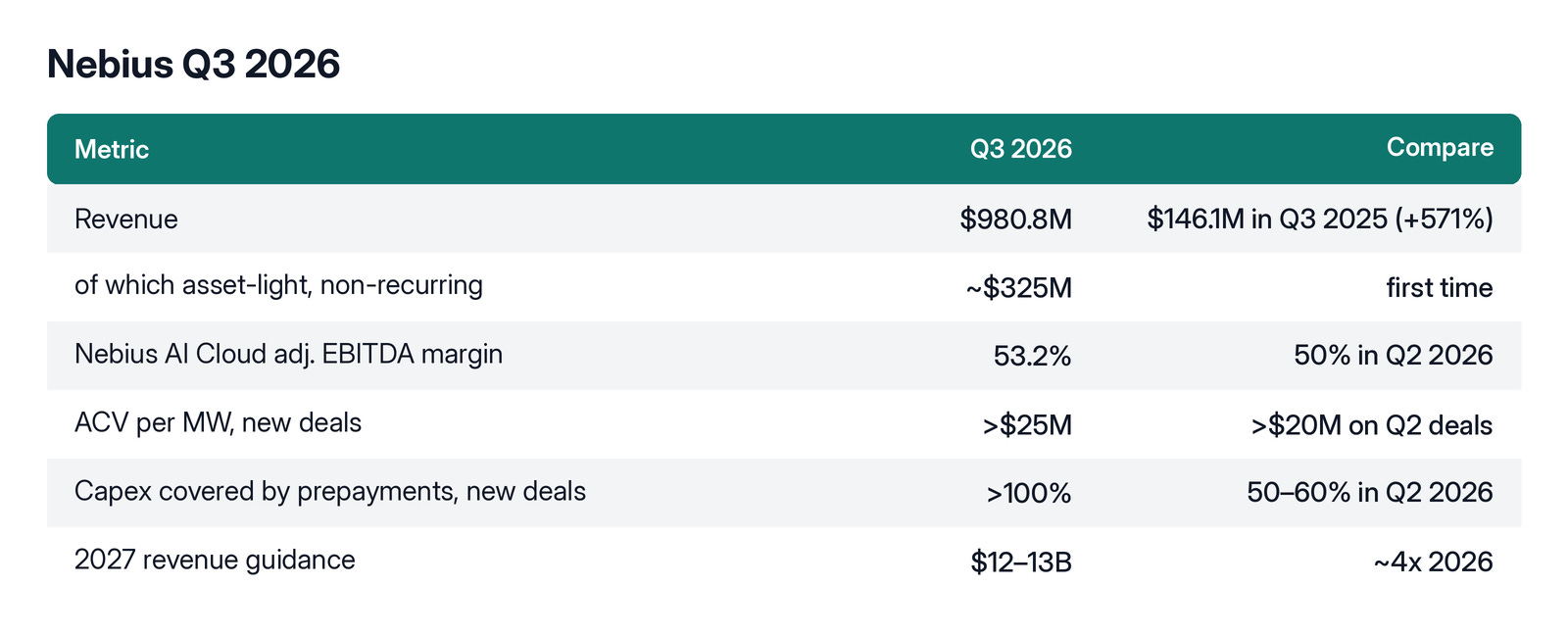
The cost: 2026 revenue at the low end of the $3.0–3.4B range, and the ARR they guided for December arrives in February.
Arkady on the call: “Customers have been kept informed and none of that capacity is canceled.”
And on their own sites: “we remain on track and even ahead of schedule.”
So Nebius will build more by itself:
We prefer to build our own sites, which give us greater control over execution and better economics. These sites are on time or ahead of schedule, and we expect they will make up most of the gigawatts we bring to market in the future.
This was part of the thesis since the beginning. My first deep dive was about full-stack verticalization: data centers, in-house hardware, software, all designed together. Nice to see they’re sticking to it.
I read this as a strong thesis validation. The engineering and execution moat is real.
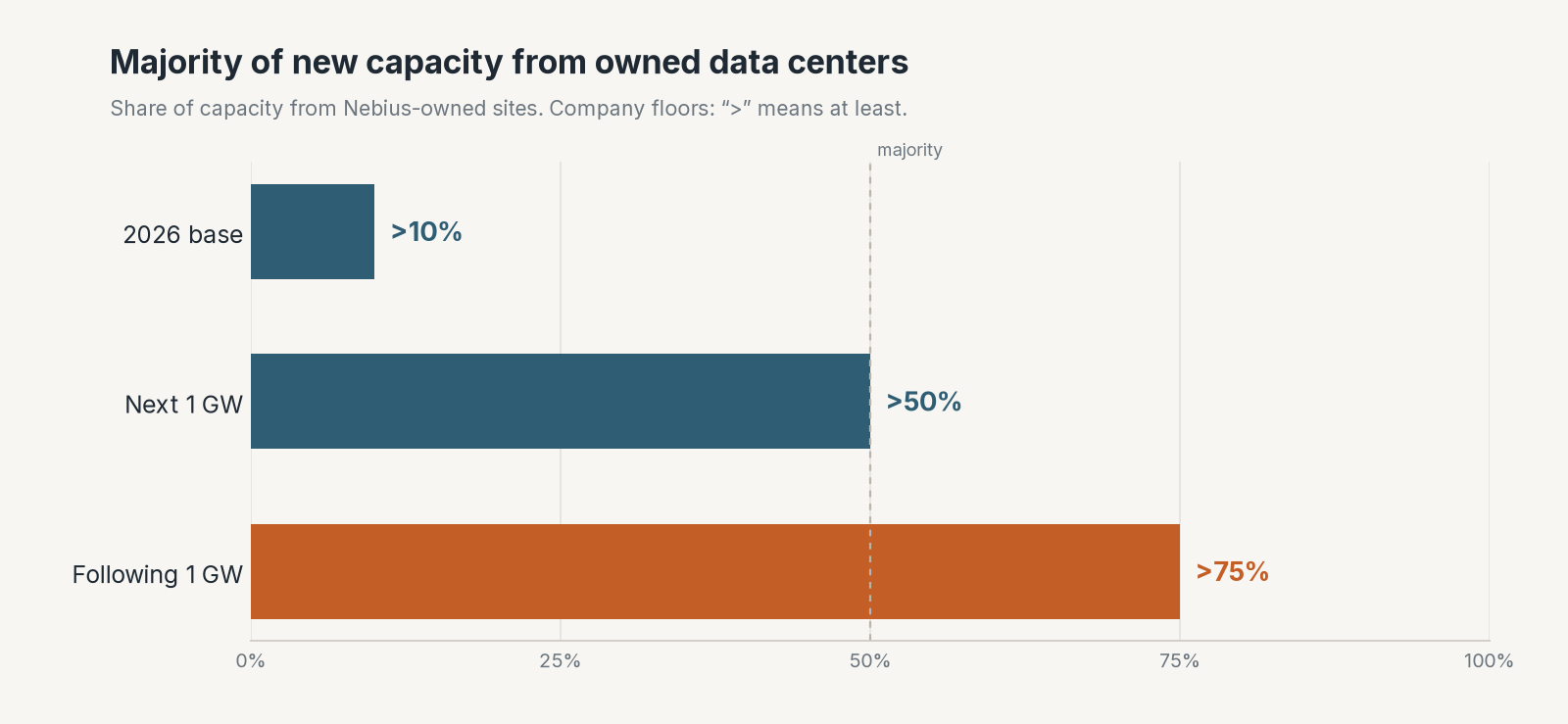
Does owning sites lift margins or just capex. Nebius answers in the letter: “Over time, these dynamics show up in our margin profile.”
Once buildings and power are in place, the only layer they replace is the compute, at every new GPU generation, on infrastructure that’s already paid for.
There’ll be turbulence in the near term. But the 2027 owned sites are named (Missouri, Lappeenranta, a second Mäntsälä site, Alabama), and they say they’ve already secured all the power and components for what they plan to bring online in 2027.
2. Capital is not an issue when demand and execution are there
Arkady opened the financing part of his letter like this: “In recent weeks our industry has been asked questions about how the AI build-out will be financed.”
Nebius’s answer: let the customer pay first.
Prepayments on deals signed in Q3 covered more than 100% of the related capex, data center construction and networking included. In Q2 it was 50–60%.
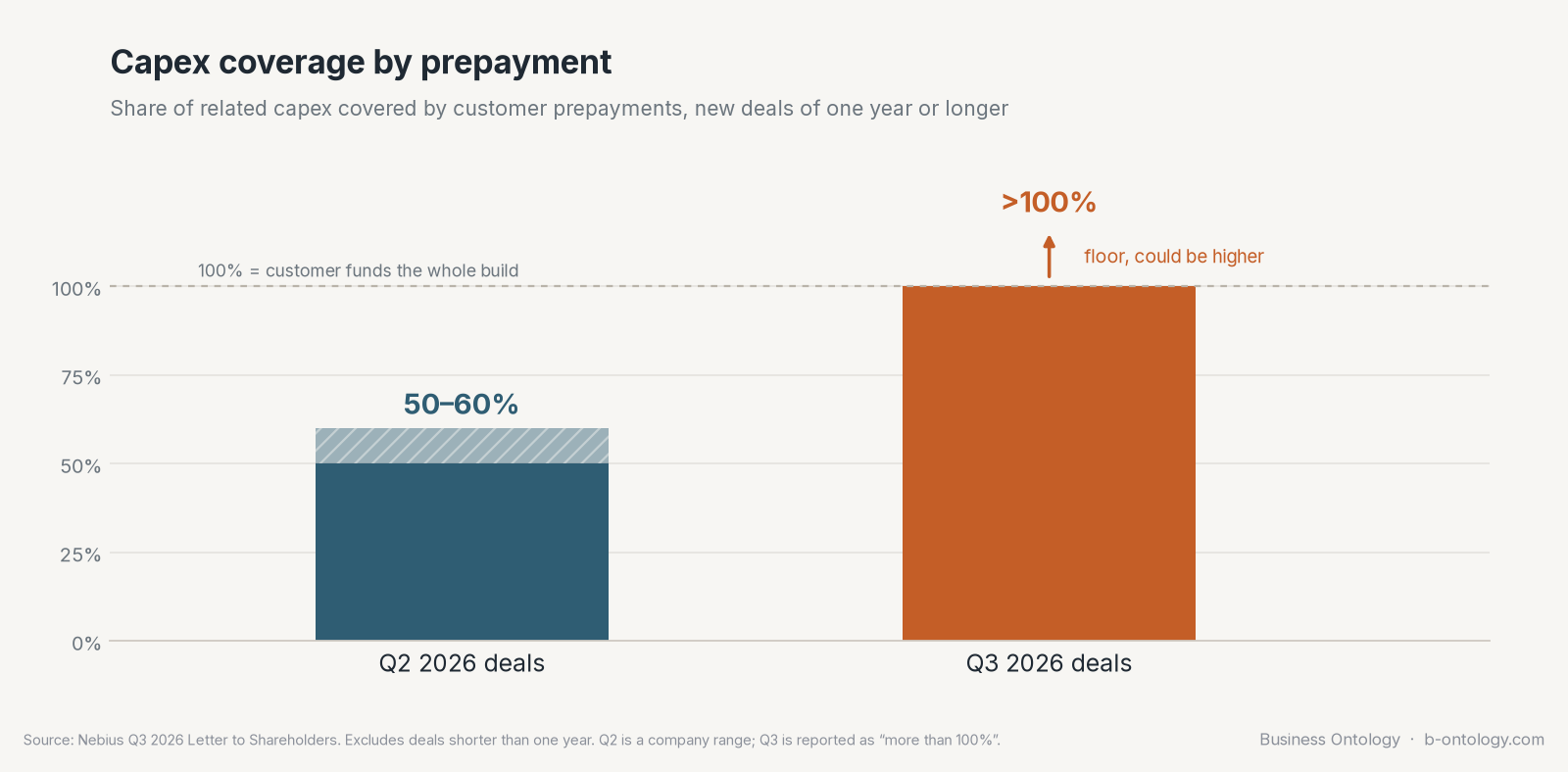
On the new deals, the customer is funding the build.
For 2027 they guide $40–45B of capex, and expect prepayments plus asset-backed financing on existing investment-grade contracts to cover 75–85% of it.
3. Demand: the market sets the price
Since the start of Q3, customers committed more than $12B in contract value to Nebius.
And they’re paying more. Annual contract value per MW went above $25M on Q3 deals, from more than $20M in Q2.
Nebius also started letting the market set the benchmark. Reserve auctions cleared above the reserve price. Live spot prices at times went above the on-demand rate. Short-term clusters price at more than twice the reserved rate.
My favorite detail: both reserve-auction winners were new to Nebius, and the first one has already expanded its contract value 10x.
They start where it suits them, then they stay. That’s the hyperscaler playbook I wrote about in Q2.
4. Tokens and enterprise
In Q1 I wrote that the world’s biggest factory will produce tokens.
Token Factory, the managed inference platform, grew contract value 17x quarter on quarter in Q3, and is approaching a multi-hundred-million-dollar run rate less than a year after launch.
That’s probably an even better leading indicator for demand than the GPU deals, since most of the compute will be about inference.
Then enterprise. Databricks, Datadog and Snowflake signed multi-year agreements for the first time. Palantir had already picked Nebius as its preferred partner in September. The ecosystem starts to sound “enterprise”.
Marc Boroditsky, the CRO, on Palantir:
I was able to actually join a bootcamp of theirs recently, and it was really exciting to see the enterprise interest in the room...
And on direct deals:
...enterprises are starting to bring on the first non-hyperscaler relationships, oftentimes for the innovation that they’re seeking to implement in their organization.
Enterprise adoption is likely close to an inflection point, as the go-to-market surfaces multiply.
My 2030 target price (base case)
Nebius doesn’t disclose how many megawatts are earning. Analysts put it at about $12M (blanded) of ARR per active MW. I start from there.
Starting point: the >$7B of ARR Nebius expects in February. At $12M per MW, that’s about 580 MW earning.
1 GW added every year, 2027 to 2030. Nebius says “more than 1 GW”. I use exactly 1.
Every MW earns the blended price, with the assumption that the blended price rises 20% a year. By 2030 that’s about $25M per MW, roughly what the new deals pay today.
The 2030 gigawatt counts for half a year.
A P/S of 2.
Dilution: this year’s pace, slowing down to 3% a year by 2030.
Put it together: about $100B of revenue in 2030, and a ~$200B market cap.
About $300 per share.
These are all conservative assumptions, so I consider this a base case. It could be much better than this. Also, this estimate covers only the Nebius AI business and does not include Nebius Group’s other stakes (ClickHouse, Avride, etc.), which makes it even more conservative.
5. Nvidia without Jensen adds risk
My first Nebius deep dive was called “Nebius: akin buying $NVDA with leverage”. The idea: Nebius revenue scales as a multiple of Nvidia’s GPU demand.
Unfortunately leverage works the same all the way down. lol.
Jensen resigned on November 12th. Colette Kress is interim CEO. On the 17th Jensen wrote that he’d be “honored” to come back. A few hours later, on Nvidia’s earnings call, the chair said the board “does not intend to reinstate Jensen as CEO.”
I think Nvidia will keep supporting Nebius, financially and technologically. The support could actually be even stronger than before, as Nvidia will focus more on financially stable neoclouds.
My worry is that without Jensen, who to a certain extent was Nvidia himself, Nvidia will slowly fall behind in terms of technology, and at that point Nebius should look for alternative solutions to remain at the frontier of computing. This is not something that will happen tomorrow, so there is time for Nebius management to address it, but it is certainly a risk that wasn’t there until a month ago.
Conclusion
Customers committed more, at higher prices, for longer, and paid up front. Thesis on track.
As always, here is the “Deep Dive To Date” (DDTD), that is, how the stock has performed since my first deep dive and when I bought in on July 28th, 2025, at $51.63.
1.6x DDTDIf you want access to:
My portfolio
all my trades in real time
my price targets and how I calculate them
Business Ontology content
Join the Business Ontology Community
My price targets will be shared in the Telegram Group and explained on my Youtube channel.
I share my thoughts on X.
I can be and will be (hopefully not often) WRONG. This is my personal strategy. Not financial advice. DYOR.