


Most Nebius customers started by using closed models and then switched to Nebius to use open models, either off the shelf or fine-tuned on their data.
From a RAISE Summit discussion, here is a quote from Nikita Vdovushkin (Product Director, Token Factory at Nebius):
And we do see that like there is like some kind of a maturity curve where people start from using closed-source models like OpenAI and Anthropic or whatever. ... When they start getting traction, the cost basically soar in the the sky and they want to have and they start to get basically just two things. The first one, they do understand their customers better and due to that they have more data on that. And the second thing, they do understand the economics and how the product works better. And they want to apply these two things to make everything like work. And obviously, for that they start to fine-tune, post-train, do something with the model. And yeah, like most of the models that run on top of Token Factory, they still, like, some versions of the open source, but basically they’re somehow customized by the customer.
This makes perfect sense. As a company, you start by testing and may even launch your AI product, or AI-powered product, with closed models: it is faster, convenient, more intelligent and it scales nicely at the beginning. But as you validate your product and make it ready for production, it doesn’t make much sense to keep using closed models. You want it to be as cheap as possible, you want control and, once you have valuable data, you want to fine-tune it. All of these needs are met by open models and a powerful and reliable token factory, which is what Nebius offers and has been investing in from the beginning.
If you have ever worked in a manufacturing company, you may find the following analogy useful. Think about R&D and Production. For the first, you want the smartest and most capable people, as you need to come up with the best possible product. But for production, you want the best trade-off between people who are smart and capable enough and the lowest possible cost. You are willing to spend whatever is needed on individual salaries to create the product, but once the product is created, you need to optimize your manufacturing process to scale in the best possible way, while maintaining decent product quality.
According to research I ran with Grok 4.5, global spending on manufacturing salaries is from 2 to 4 times greater than global spending on R&D salaries. This data doesn’t need to be exact; being directionally correct is enough to prove my point about where the biggest opportunity is.
This doesn’t necessarily mean that global spending on open models will be greater than global spending on closed models. In fact, we have seen the opposite trend over the last 6 months: while tokens on open models are gaining share of total token usage versus closed models, in terms of spending the opposite is happening, and closed models are gaining revenue share (note that this data comes from a Vercel report, and open models are likely underrepresented here because fully self-hosted and direct-provider traffic is missing, but that only strengthens the observed direction: even in this gateway-heavy slice of the market, open models are already rapidly gaining token share while closed models continue to capture the vast majority of spend).
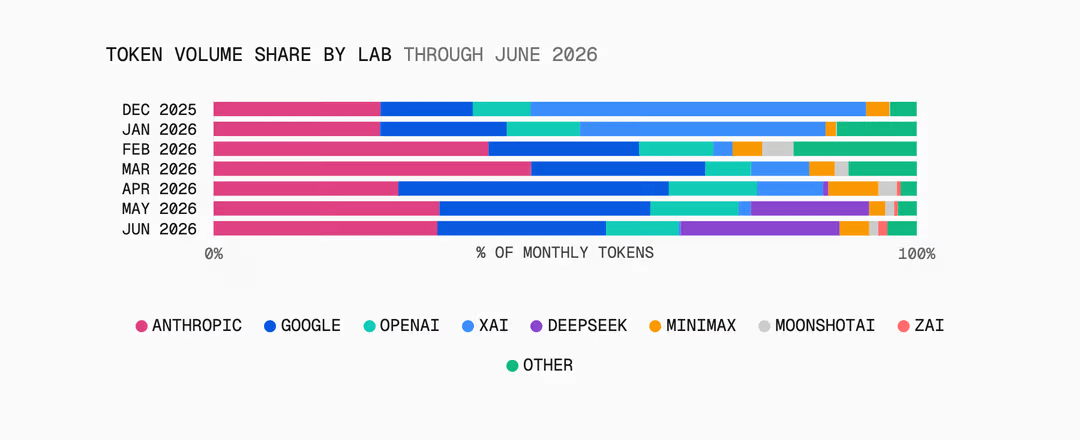
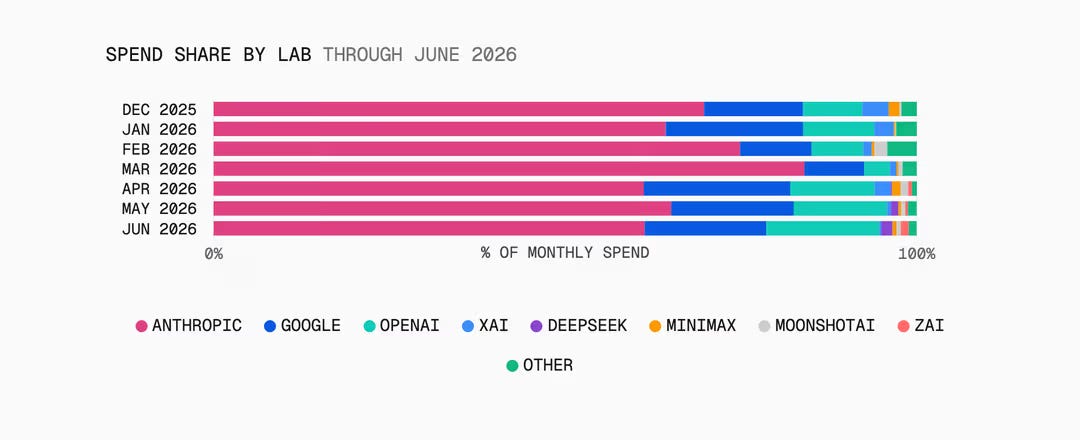
This actually makes perfect sense and supports my point.
More and more tasks will be accomplished by open models. But as you always need to create the best product and do better than the competition in coming up with new products and services, you are incentivized to use the best frontier model for some more strategic tasks. You cannot afford not to use the best intelligence available if you don’t want to be outcompeted.
So companies (and states too—think of departments of defence) will always be willing to pay a premium for specific critical use cases. And as we are still super early in the AI journey, it makes total sense that companies are still increasing their spending on closed models.
Quality of revenue and switching costs
Two main factors make the revenue of open-model providers which will be able to build a moat around software tools (like Nebius) better in quality:
A company using closed models to experiment, test, build a product, discover stuff or do science is actually quite likely to fail, especially if it is a start-up developing and launching a new product. In that case, its revenue is only temporary for the frontier lab. A company running its workload on Nebius has likely already validated and market-proven its product using closed models, meaning that the chances of that revenue being permanent and growing are much higher.
Although frontier labs are trying to build stickier and stickier tools to allow their customers to build agents and harness the raw model for a specific use case, if (or I should say when) their frontier model is leapfrogged by a competitor lab, the incentive for their customers to change provider could become compelling, as the strongest value delivered is the intelligence. On the contrary, if you have built on Nebius Token Factory, you have probably invested a lot of effort and money to fine-tune a model for your specific use case, and the incentive to go back to closed models is basically zero.
The arguments in favour of open models, and in particular of a provider like Nebius that is building a moat on what I have just explained above, are compelling and proven at this point.
This is not financial advice, remember that I have a position in Nebius.
If you want access to:
My portfolio
all my trades in real time
my price targets and how I calculate them
Business Ontology content
My price targets will be shared in the Telegram Group and explained on my Youtube channel.
I share my thoughts on X.