


SpaceX says it can bring 10 gigawatts of new compute online in 2027.
Nebius plans a bit more than 1 gigawatt a year from 2027.
That’s about 10x. And I own both.
The bottleneck Elon pointed at isn’t chips. It’s turbine blade casting. And he says SpaceX already has the most advanced casting shop on earth, built for its rocket engines.
If that edge holds, SpaceX brings power online 12 to 18 months before everyone else. That’s a big if, and I’ll get to why.
So I built a scoreboard: SpaceX, Nebius, CoreWeave and IREN. Who grows fastest in 2027, which pair I’m sticking with, and what would make me change my mind.
Let’s find out.
First, I am more and more convinced that this is the most important quote (it’s from Elon) investors should bear in mind in the singularity: “In tech the winner is not the company that is ahead at any point in time; the one who moves faster wins.”
And it looks like SpaceX is moving faster than anyone else in the AI buildout.
Elon, in the Q3 call a few days ago, pointed out that the ultimate bottleneck is now the gas turbine blade casting:
So we’re casting the blades and vanes for the turbines. So SpaceX already has a very advanced castings capability that was developed for rocket engines. So we have, I think, actually the most advanced casting capability on earth because the demands for castings for rocket engines exceed the demands for everything and anything else you could possibly imagine.
So taking that incredible team that has, I think, objectively, the most advanced casting technology in the world and saying, hey, can you guys also make some blades and veins for terrestrial turbines is much easier than what they have done in the past. And when we talk to the turbine suppliers, they tell us that the blades and vanes are 12 to 18 months behind the rest of the turbine, meaning they can deliver everything except the blades and vanes 12 to 18 months before they can deliver the blades vein. So casting is this really difficult bottleneck. And if anything, it seems to be getting worse.
So that means that we can bring power online 12 to 18 months faster than anyone else.
Of course, few can replicate that quickly at meaningful scale. Incumbents already cast turbine blades, and SpaceX’s own blade output at that speed is still unproven. If the edge holds, it’s a moat as long as demand stays overwhelmingly higher than supply.
Nebius, on the other hand, despite moving slow in comparison to SpaceX, is not moving slow compared to neoclouds.
Indeed, if we compare it to IREN and CoreWeave by using their Capex as a proxy for the compute they will bring online, Nebius’s higher sequential acceleration and speed are clear.
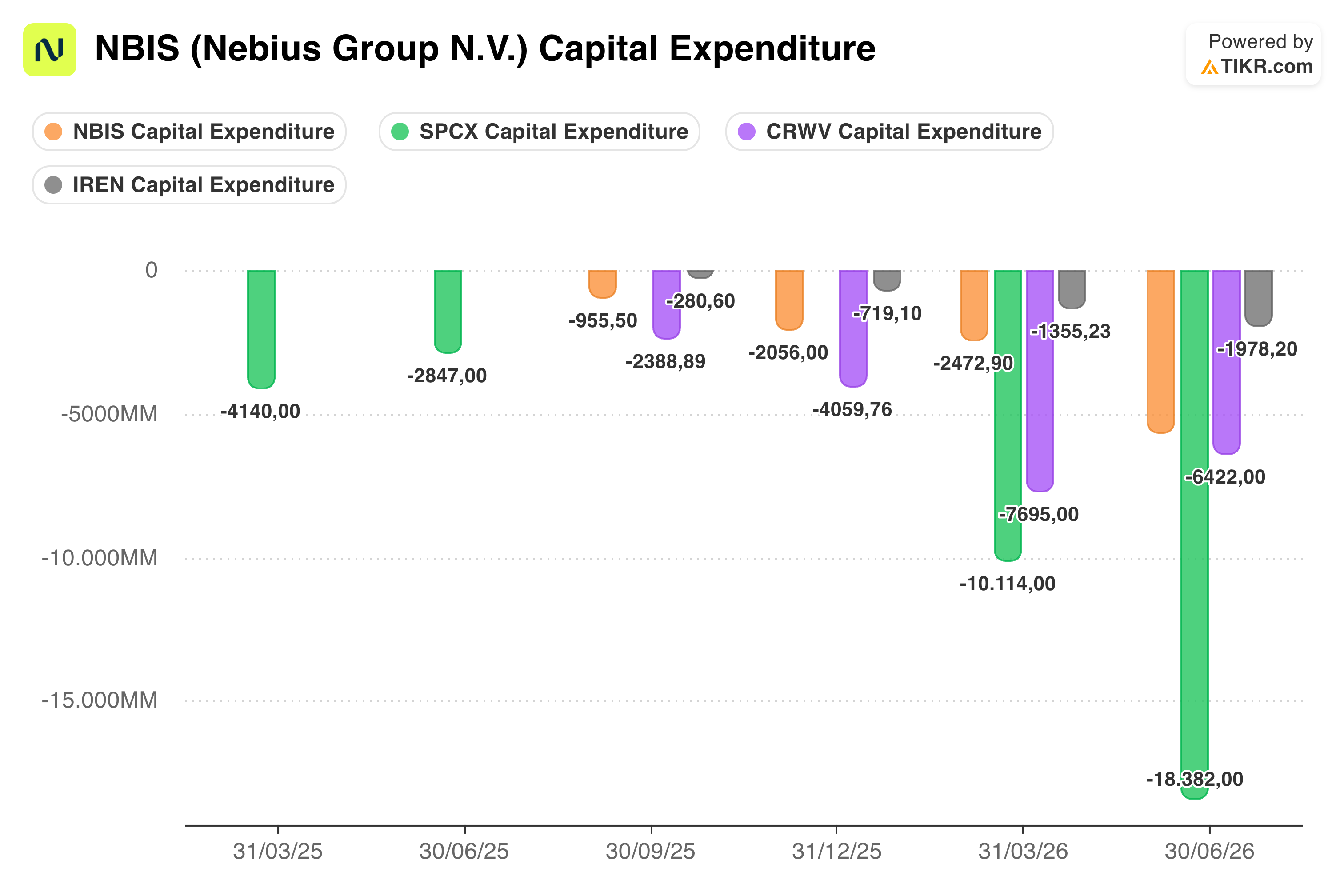
I know Capex is not a perfect metric to measure it, but for the purpose of this high-level comparison it is likely good enough.
Ready for Multibaggers? Unlock all my in-depth analyses and updates, including coverage of $NBIS, $MELI, $LMND, $HIMS, $RKLB, $ODD, $ZETA and $SPCX, by visiting Lorenzo2cents. Want the latest articles delivered straight to your inbox? Subscribe here for FREE and stay ahead of the curve.
Now, let’s assume for a moment that SpaceX, Nebius, CoreWeave and IREN are all equally good at building and monetizing compute. With this assumption in place, the incremental revenue per year should roughly equal the incremental compute multiplied by the price of compute. The price of compute (assuming demand holds) is a sequential positive multiplier (the trend is positive, it’s increasing), but it is the same for all the companies because of assumption number 1 (all as good).
So what really matters for relative revenue growth is the incremental compute divided by current compute.
Now, because of the initial hypothesis, in 2027 SpaceX will bring online 10 gigawatts, Nebius 1 gigawatt, and CoreWeave (whose absolute Capex is still higher than Nebius’s, though the quarterly gap is narrowing as Nebius accelerates faster) about 1.15 gigawatts based on company guidance. On Capex, IREN looks like the least incremental spender. By the way, IREN may benefit from the reconversion of some mining assets and so need less capital to bring compute online, but again, here we are measuring the acceleration and speed of the buildout, and incremental Capex still makes sense with IREN too.
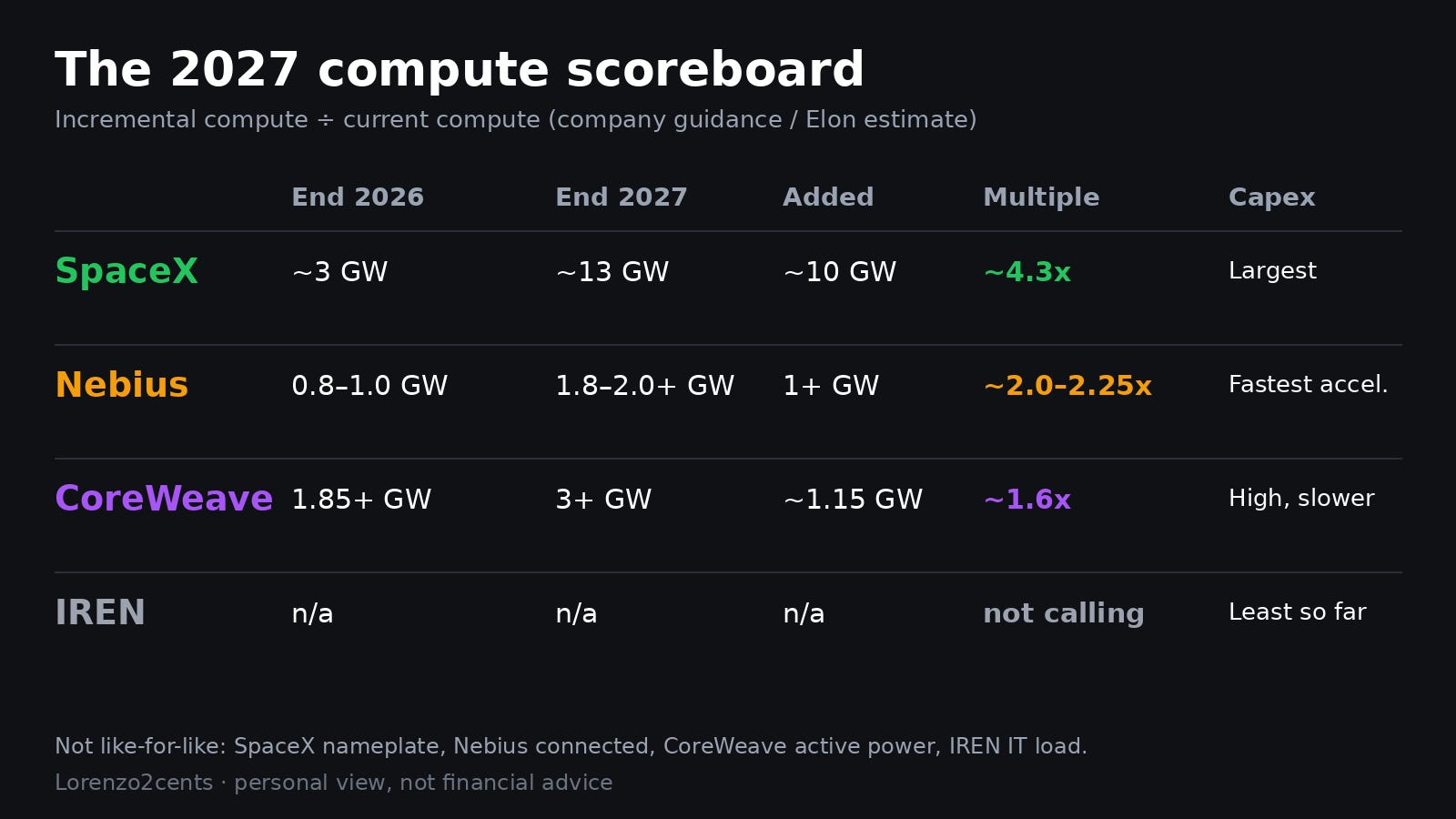
So let’s see the incremental compute divided by current compute, all measured in gigawatts, for 2027.
These GW figures aren’t strictly like-for-like (nameplate, active power, connected capacity, …), but they are good enough for this high-level relative growth comparison.
Nebius should end 2026 with connected capacity around 800 megawatts to 1 gigawatt (company guidance), and plans to deploy more than 1 gigawatt per year starting in 2027, meaning that in 2027 it is increasing about 2x to 2.25x (from 0.8–1.0 to about 1.8–2.0+ gigawatts).
SpaceX should end 2026 with compute around 3 gigawatts (Elon’s estimate), meaning that in 2027 it is increasing slightly more than 4x (from 3 to 13 gigawatts).
CoreWeave should end 2026 with active power of more than 1.85 gigawatts (company guidance), and guided for more than 3 gigawatts by end of 2027, meaning that in 2027 it is increasing about 60% (from 1.85 to 3 gigawatts).
For IREN, I don’t feel comfortable making a GW prediction because of what I have said above regarding the existing assets and the Capex picture so far, but the most likely outcome is still fast acceleration (maybe like SpaceX or Nebius) in 2027.
Here’s the scoreboard in one place:
Another assumption I make is that the growth of compute from 2028 on, in absolute terms, won’t be much higher for these companies than in 2027, as there is a limit given by physical resources (you don’t scale as in software), meaning that percentage growth will keep diminishing until it gets irrelevant in a few years.
In other words, although there are certain economies of scale like expertise and supply chain, returns to economies of scale are decremental over time, until you reach a tipping point where you keep building the same amount of compute per year or less (resources like land or natural gas are finite), unless you find a new breakthrough in tech.
SpaceX may be the exception here, thanks to orbital datacenters, which in my view should become a thing moving toward 2030 and could allow it to keep growing at high rates for longer.
There are a couple of other advantages that SpaceX has compared to other hyperscalers, and even more so compared to neoclouds.
The first is that they are selling the capacity dedicated to third parties mostly on short-term contracts priced near spot, which means that they will capture the full benefit of rising compute prices.
In contrast, neoclouds rely more on long-term, fixed-price contracts with hyperscalers to secure the credit needed to finance the Capex. This is especially true for CoreWeave.
Nebius also uses long-term investment-grade contracts, mainly to finance the build, while trying to limit them as they aim to become a hyperscaler themselves.
The second advantage SpaceX has against neoclouds is that they have internal demand coming from Grok, Cursor and Grok Bot, which is potentially offsetting a possible tempering of third-party demand that, even if not in sight, could still happen eventually. This is an optionality that I expect Nebius to enjoy more and more too, for the same reason I explained: they are focusing on getting their own end customers.
And demand isn’t what’s binding right now. Power is: Elon himself warned this week that a lot of AI compute could end up stranded in half-finished data centers.
Conclusion
My conviction in SpaceX is only getting stronger, and I believe that, together with Nebius, SpaceX is the best play to take advantage of the AI buildout.
With the Q3 earnings they reiterated they are on track to deliver their guidance of $100 billion in ARR by the end of this year, and Elon said that implies annual recurring revenue by the end of ‘27 somewhere between $500 billion and $1 trillion, which makes sense if you consider the 4x+ increase in compute plus the expected increase in spot price.
Ultimately, whether the bottleneck is the gas turbine blade casting, chips or anything else, Elon will go after it and build what is needed himself.
My ranking (not considering valuations): SpaceX first, Nebius second. That’s the pair I’m sticking with. IREN and CoreWeave come after.
As always, here is the “Deep Dive To Date” (DDTD): stock performance since my first deep dive and when I bought SpaceX on August 21, 2026, at $112.
+32% DDTDIf you want access to:
My portfolio
all my trades in real time
my price targets and how I calculate them
Business Ontology content
My price targets will be shared in the Telegram Group and explained on my Youtube channel.
I share my thoughts on X.
Personal views, not financial advice. I can be wrong, and sometimes I will be. Do your own research.
Whoever moves faster wins. Right now, that’s SpaceX.