


Lemonade Q2 2026 was stellar, even better than the previous quarters, which were stellar too. Yet, the stock price closed down 24% that trading day, I suppose driven by algos (it happens every time with Lemonade’s earnings) and retail investors freaking out about a self-inflicted narrative of opex being out of control.
This is my opinion, of course, and I can be wrong, so do not take this as financial advice.
Developing a thesis about an investment, owning it and monitoring it is tougher than one might think. That’s why I have developed my method, which I call the Business Ontology Framework.
It helps me think from first principles and identify the relevant metrics to monitor that are, as much as possible, leading indicators of how the thesis is unfolding.
I am going to explain in this short write-up what I think matters and why. First, my thesis: Lemonade is going to become an autonomous company, and this will allow a winner-takes-all scenario.
I’ll keep it simple and short here, as you can find a lot more details by checking my past articles on the matter.
Follow me in my first-principles thinking here. To become an autonomous company and thrive in the insurance market, Lemonade needs to:
Make human employees more and more productive over time, let’s say at least 2 times more productive than the most productive competitor
Be able to acquire customers profitably for decades
Be able to retain customers
Keep risks under control
That’s it. Really, that’s it.
If Lemonade keeps doing these four things better than others, it will become a $100B company in less than ten years, and a $1T company in less than 15 years.
Everything else doesn’t really matter. It’s noise.
Let’s now look at how to assess if Lemonade is on track to deliver in Q2 and onward.
Make human employees more and more productive over time
There is really one simple metric here that tells us if Lemonade is on track, and it is
In Force Premium (IFP)/Employee
Here is how it printed in Q2 and its trend over the last quarters.
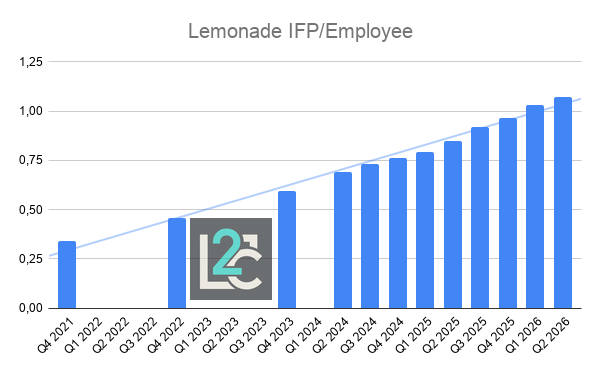
It must keep going up. Anything else doesn’t matter. Period.
You may see headcount or salaries increasing; it doesn’t really matter. In the long run, what matters to validate the autonomous company thesis is how productive employees are.
How much they are leveraged by technology.
Financials will inevitably follow, eventually.
Now, the IFP/employee trend is for sure a leading indicator, but if we want an even better one, it is probably the LAE ratio. Even though it is less complete, as it covers only part of the business, it is a useful proxy for claims-handling efficiency. Lemonade says the improvement is being driven by the growing use of its OS and AI across claims operations, so I see it as evidence that automation is increasingly supporting the business.
If Lemonade is achieving this trend in claims management, we can reasonably assume that something similar is happening in other areas of the business, such as risk management and customer acquisition.
This is how the LAE ratio trended over time and printed in Q2.
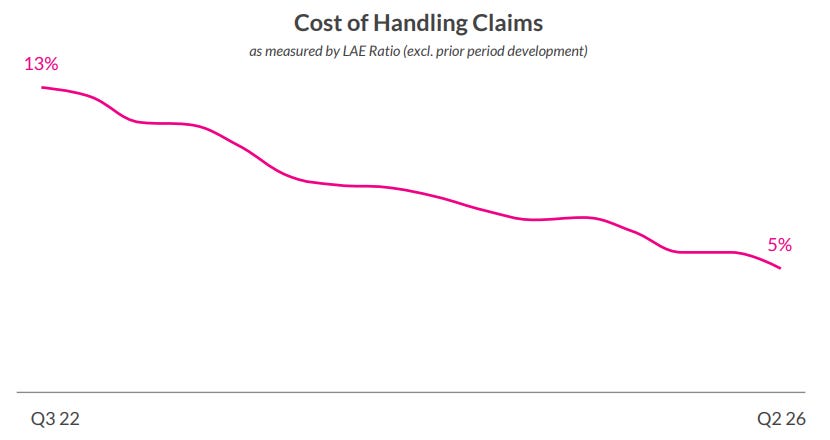
Of course, the lower the better. Currently, it is already one of the best in the industry, if not the best.
Be able to acquire customers profitably for decades
This is crucial, even more so for a D2C business, because if Lemonade were to lose the ability to acquire new customers profitably, it would be a survival issue. Lemonade would likely need to change its go-to-market, starting to rely on human agents, the same as its competitors, which of course would invalidate the thesis.
Just think about what happened to Oddity Tech ($ODD). I recommend every Lemonade investor learn about it, as it is a good case study to understand how important this ability is for Lemonade.
The best indicator of this ability is
Lifetime Value/Customer Acquisition Cost (LTV/CAC)
This value has consistently been held at approximately 3x, which is a healthy level, as reported by management.
I see two positive trends here, both driven by scale.
As Lemonade becomes bigger and operates in more geographies and with more products, its ability to cross-sell improves. This means the same customers will buy more products, which means a higher LTV.
If we look at the denominator, CAC, the same driver helps. More customers, more products and more geographies mean more data and more targets, and therefore a higher probability of finding highly rewarding and efficient campaigns to run. To understand this point, you can read how they deal with marketing campaigns here (from an old report):
Going deeper, the second quarter saw the launch of our 6th generation Lifetime Value machine learning model (”LTV6”). This is our most advanced, credible, nuanced and precise LTV prediction model to date (a synthesis of several models, to be precise).
For each customer we on board, LTV6 offers a prediction of their likelihood to churn, claim, and cross sell - and from these it derives a predicted lifetime value. This is the projected net stream of dollars, discounted for the time value of money, from each customer (i.e., all premiums, minus all claims, adjusted for net present value).
Once they reach statistical significance, each product, each market, and each campaign is likewise scored using LTV6. After adding the customer acquisition cost (CAC) into the formula, the resultant LTV/CAC, together with the CAC Payback Period, determine which product, market, and campaign receives the incremental dollar spend.
This is what Shai said about it during the last earnings call:
We seek to increase LTV through sustained momentum in cross-sells, which can drive gains in retention. And we seek to improve CAC efficiency through more granular AI-driven pricing, which can provide a tailwind to conversion rates. We continue to focus on these key drivers that we believe can drive sustainable profitable growth.
Being able to retain customers
This metric is strictly correlated with the previous one, as it is the other side of the coin. Indeed, every customer retained is worth the same as a customer acquired (or even more as it does not require CAC). In other words, 1 is worth 1: either you gain it or you lose it. And better retention has a positive impact on LTV and vice versa.
Annual Dollar Retention (ADR) is the king metric here.
It held stable sequentially at 85%,
…continuing to reflect the impact of our prior clean the book actions within our homeowners product line. And as a reminder, ADR is measured relative to prior year’s IFP. So, while those portfolio actions are now largely behind us, they will continue to impact the reported ADR metric for the next couple of quarters before rolling out of the comparison period.
Management is basically saying that we will see ADR improving in a couple of quarters.
Where can it go?
Its peak of 88% was reached in Q1 2024, and the drop was due to the “clean the book” actions, based on what we know from management. This makes me think it can go back to that level, but even higher given that Lemonade now has more products to sell (it added Car), which of course is an incentive for customers to remain loyal. So I wouldn’t be surprised to see an ADR of 90% or more in 2027.
ADR is a lagging indicator though, meaning that when you see it changing, it could be too late. As a leading indicator, I instead like to use customers reviews. The rationale is that if customers are satisfied, they will stay. If not, they will change.
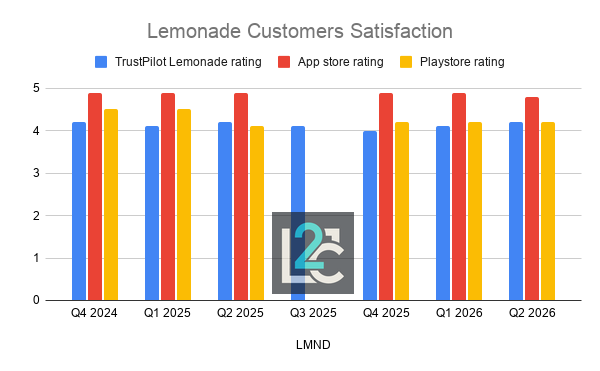
As long as Lemonade is rated 4 or above, I feel pretty comfortable with the expected ADR.
Keeping risks under control
This is the essence of an insurer: being able to accurately predict the risk of having to pay a claim and run the business accordingly.
The loss ratio is the king metric here. But as the loss ratio has to be seen as a trade-off between bearing a reasonable risk and keeping prices attractive enough to grow, I like to represent it with my proprietary adjusted rule of 40:
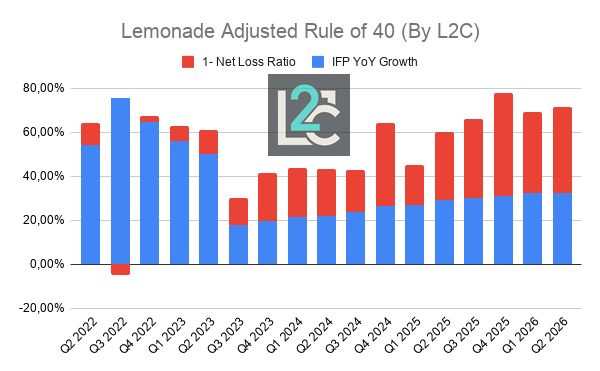
The beauty of this graph speaks for itself.
Given that for Car, the last product introduced, the loss ratio is following a similar path, I consider this part of the equation solved for Lemonade.
Profitability
Although important, of course, being obsessed with profitability is a waste of time and focus. Reasoning from first principles, if Lemonade keeps delivering on the four points that I have outlined, it will eventually become the most profitable insurer in the world.
If you are a long-term investor, you may actually want Lemonade to be as unprofitable as possible for a long time, as long as the cash is spent to grow faster.
Anyway, for the fetishists of profitability, I have at least two pieces of good news for you too.
Lemonade has two further important levers for profitability: reinsurance and Synthetic Agents.
During the quarter, we also completed our annual reinsurance renewal as well as the extension of our synthetic agents program with important upgrades to each. As it relates to reinsurance, the renewed program modestly increases the share of premiums that we retain while meaningfully strengthening catastrophe protection, including named storm coverage that was largely absent under the expiring structure.
Reinsurance is a way to lower risk and use less capital. As Lemonade is already doing, it will likely reduce the reinsured portion as it scales and has more capital available. Or maybe it will prefer (which is what I hope) to reinvest the capital to grow faster and keep the reinsurance share higher. The point is that once it has a meaningful capital surplus every quarter, being more or less profitable by retaining a higher or lower portion of the premium will be just a strategic decision.
Even more compelling is the argument for the Synthetic Agent program.
The agreement related to our synthetic agent extension provides $0.25 billion in growth financing at roughly 9.8% cost and applies to growth spend in ‘27 and ‘28. This amounts to more than 6 percentage points improvement in our cost of capital, materially lowering expected interest expense on a go-forward basis.
Lemonade secured a future reduction of more than six percentage points during Q2, which will be reflected in the financials of 2027.
As above, once enough cash comes in every quarter, Lemonade may decide to quit the program and bring the interest paid on growth to zero.
Conclusion
I’ll say it again: if Lemonade delivers on the four outlined points, it will be the most profitable insurer in the world.
As always, here is the “Deep Dive To Date” (DDTD), which shows how the stock is performing since my initial deep dive on September 24th 2024, when the stock price was $17.23.
2.8x DDTDIf you want access to:
My portfolio
all my trades in real time
my price targets and how I calculate them
Business Ontology content
My price targets will be shared in the Telegram Group and explained on my Youtube channel.
I share my thoughts on X.
I can be and will be (hopefully not often) WRONG. This is just my personal strategy—NOT FINANCIAL ADVICE. I don’t know your financial or life situation well enough to give any recommendations. Please do your own due diligence and research. Don’t be LAZY.
Be the architect of your own destiny.
Ciao
Lorenzo
Great Article, and Agreed on all points, I’ve been tracking the company for a while and wanted to surface two questions on 1 Loss and Loss Adjust Expense 2 Homeowners Multi‑Peril stagnation. Even accounting for higher NEP from the reinsurance transition, the Loss & LAE as a % of revenue has spiked. Feels like recent claims might be higher, but the impact is getting masked by PDD gains, especially since the Attritional Gross Loss Ratio is the highest in 7 quarters. Second, Homeowners Multi‑Peril: 39% of IFP, but growing only 5–6% YoY. Is this a cautious strategy? A deliberate shift away as High CAC lines, or structurally limiting expansion? Curious whether this drag meaningfully caps overall growth. Would love to understand your thoughts on it.